Paul Brown
UK, 1947
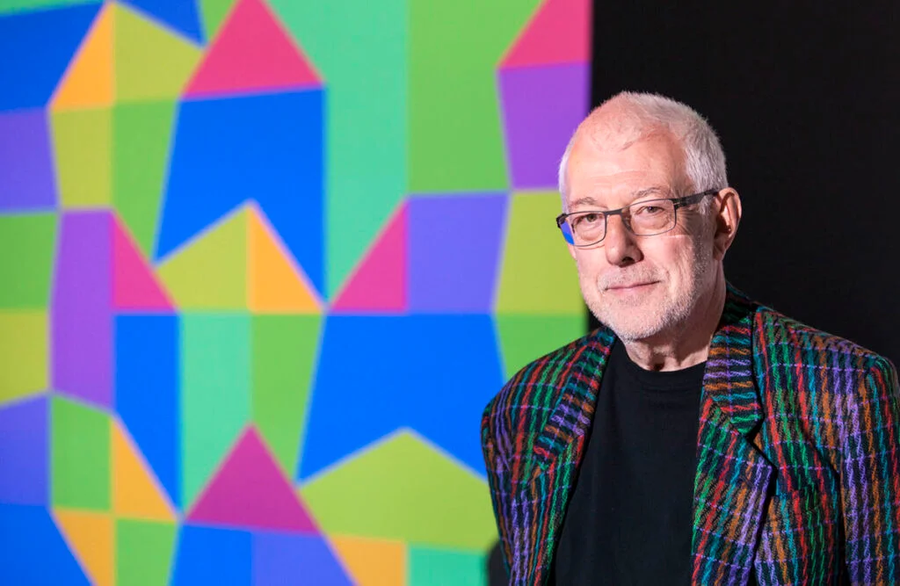
Paul Brown is an Australia-based artist who has been a pioneer of computational and generative art since the late 1960s.
Artwork in the Encyclopedia of New Media Art archive
Double Dragon

About the artwork
Double Dragon is a kinetic painting created by digital colonies of artificial agents, small programs that use artificial intelligence and artificial life to interact. Each agent observes its neighbours and adjusts its behaviour to the overall state of the group, and from these simple rules emerge patterns, movements and forms that no single agent could produce alone. It is, as Brown puts it, ‘a kind of art that makes itself,’ in which the final image is not designed but emerges from the system. Brown began working with generative systems in the 1960s, influenced by Systems Art and Art Concret, European movements rooted in Constructivism, De Stijl and the Bauhaus. He calls this approach ‘the Geometric Sublime,’ where simple rules give rise to ‘an immense and unexpected richness of form.’ The word ‘colonies’ also carries another meaning: it acknowledges Australia’s post-colonial legacy, and Brown pays his respects to the Minjungbal people of the Bundjalung Nation, traditional custodians of the land on which he lives and works.
Artistic career: Paul Brown
Artistic practice and research
Paul Brown (UK, 1947) is an Australia-based artist who has been a pioneer of computational and generative art since the late 1960s. Influenced by Systems Art and Constructivism, he creates works in which images emerge from simple rules rather than direct design. He co-edited White Heat Cold Logic, a history of early British computer art, and his work is held in collections such as the Victoria and Albert Museum in London.