

Chris Speed
UK, 1970
Chris Speed is an artist, designer and researcher whose work looks at how digital networks and data are changing the way we move through places, use objects and relate to one another.
Artwork in the Encyclopedia of New Media Art archive
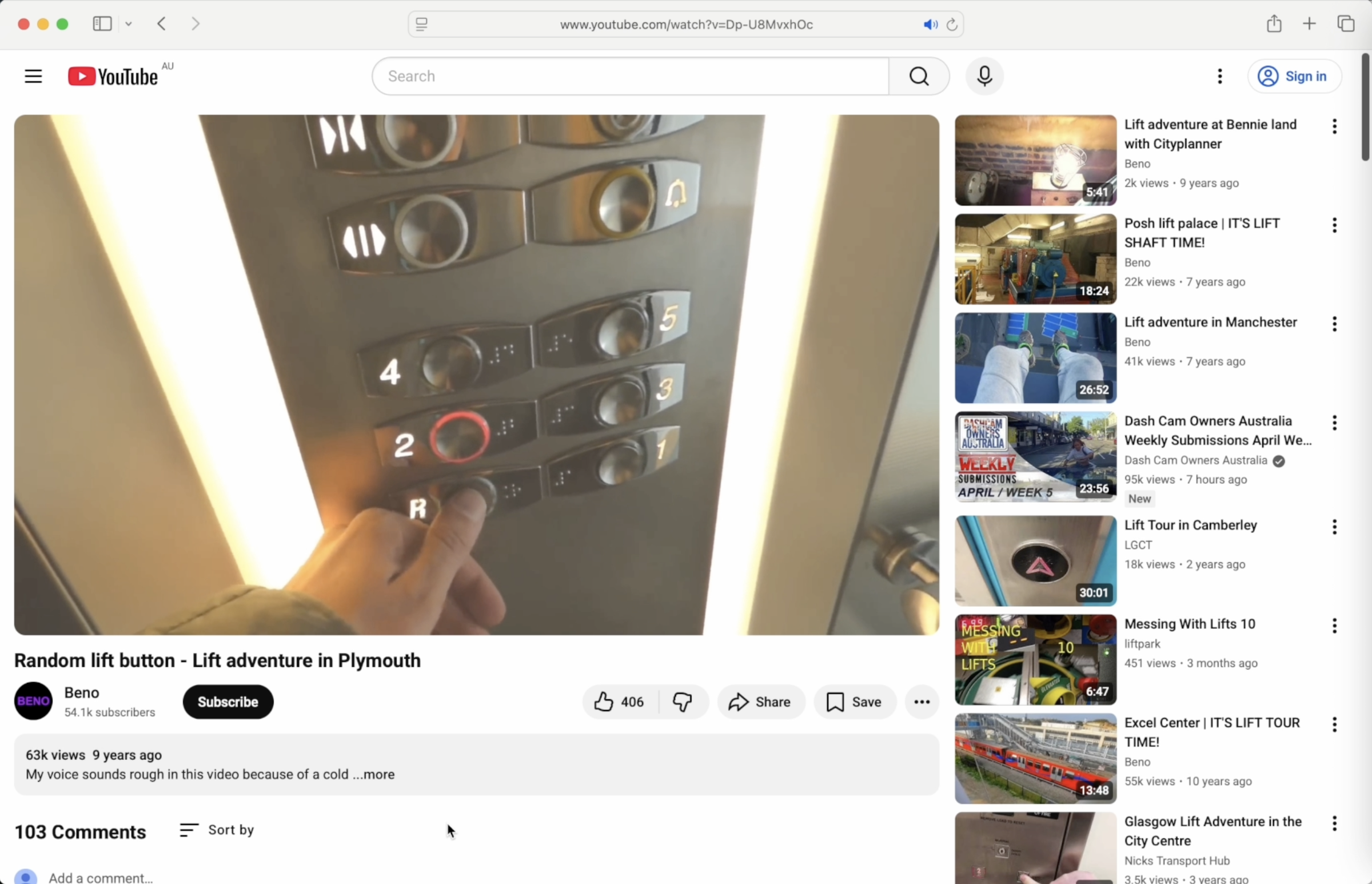
Random Lift Button
About the artwork
In 2002, Speed installed two extra buttons in the lifts of the University of Plymouth’s Portland Place building, each wired to send passengers to a random floor. The work grew from his interest in how capitalism turns time and space into economic currencies. Lifts, he argues, are a perfect expression of that logic: they compress space, skip the journey between floors and deliver people straight to their next productive task, making corridors, stairwells and the social life of a building almost invisible. An ordinary lift button, he writes, ‘promises teleportation rather than travel, destination rather than journey,’ much like a hypertext link. By adding a single element of chance, the random button restores the possibility of getting lost, of encounter and of seeing the building as a continuous whole. What is shown here is not Speed’s own documentation but a 2016 YouTube video by the vlogger BenO, who came across the button and filmed his own ride, since watched more than 63,000 times. For Speed, this is where the work truly lives: as an event shared across the network, ‘authored not by the artist but by the network itself.’
Artistic career: Chris Speed
Artistic practice and research
Chris Speed (UK, 1970) is an artist, designer and researcher whose work looks at how digital networks and data are changing the way we move through places, use objects and relate to one another. He began his career at the University of Plymouth and is now Chair of Design Informatics at the University of Edinburgh, where he has led numerous research projects bridging art, design and technology.