1953 New York, EUA
Peter Halley
Lives and works in New York. Peter Halley is one of the most influential artists on the international scene. He came to prominence in the mid-1980s as the promoter of the so-called Neo-Geo movement. Although he uses geometry as a fundamental support of his works, he always insists on its figurative reference: the space and time of our society, its political and social terrain, the closed order in which we live. His cold, rectilinear forms are the visual expression of our complex urban landscape: rectangular cells connected by networks of conduits, prisons, diagrams, isolated organisms. His characteristic Roll-a-tex texture and expressive use of colour also refer to our social environment, establishing affinities with Pop Art, digital information and mass culture.

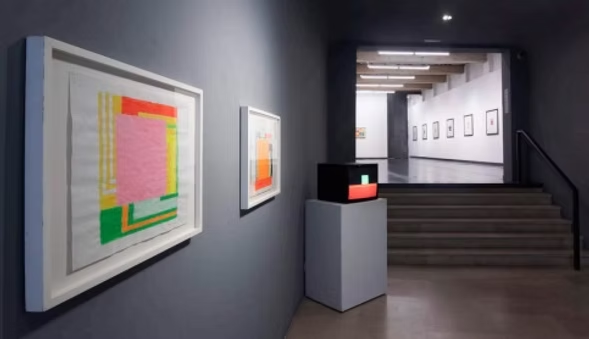
Work in the collection: Exploding Cell, 1983
https://www.peterhalley.com/
Exploding Cell, 1983
Exploding Cell (1983) is a pioneering work in “computer animation” that generates spaces from lines. These cells allude both to Foucault’s “grid” of the control society and to computer circuits.
This two-minute computer animation from 1983 is Halley’s only moving-image work. A line drawn from left to right becomes a horizon with a cell. A black conduit appears below and is “lit with a glowing gas”, with leaks through a chimney before the cell turns red and explodes, leaving a pile of ashes that flickers with a stroboscopic effect. Halley explains: “The idea had something to do with Cold War politics and the threat of nuclear destruction, since the cell explosion was originally about the end of civilisation. But the narrative of the exploding cell very quickly became a constant part of my work. Then, over time, the narrative lost importance for me and eventually I began to focus solely on the icon of the explosion. The more I think about it, the more convinced I am that the explosion is also a central image in our culture. It goes back a hundred years to the beginning of modern war and terrorism. I have used the image of the explosion over and over again in my wall-sized digital prints, in contrast to the cells and prisons depicted in my paintings. The two motifs have really allowed me to establish an opposition between classicism and romanticism. Cells represent confinement but also allude to order, a classical order that does not change. On the other hand, the explosion is always an image of change, referring to a transformation from one state to another. I find it interesting to juxtapose these two opposing attitudes. Nietzsche used the terms Apollonian and Dionysian to describe the dichotomy between classicism and romanticism.” ARCO/BEEP Electronic Art Award – 19th edition