

Paul Sermon
UK, 1966
Paul Sermon is a pioneer of telematic art who has explored how people meet and interact across networks since the early 1990s.
Artwork in the Encyclopedia of New Media Art archive
Homo telematicus
About the artwork
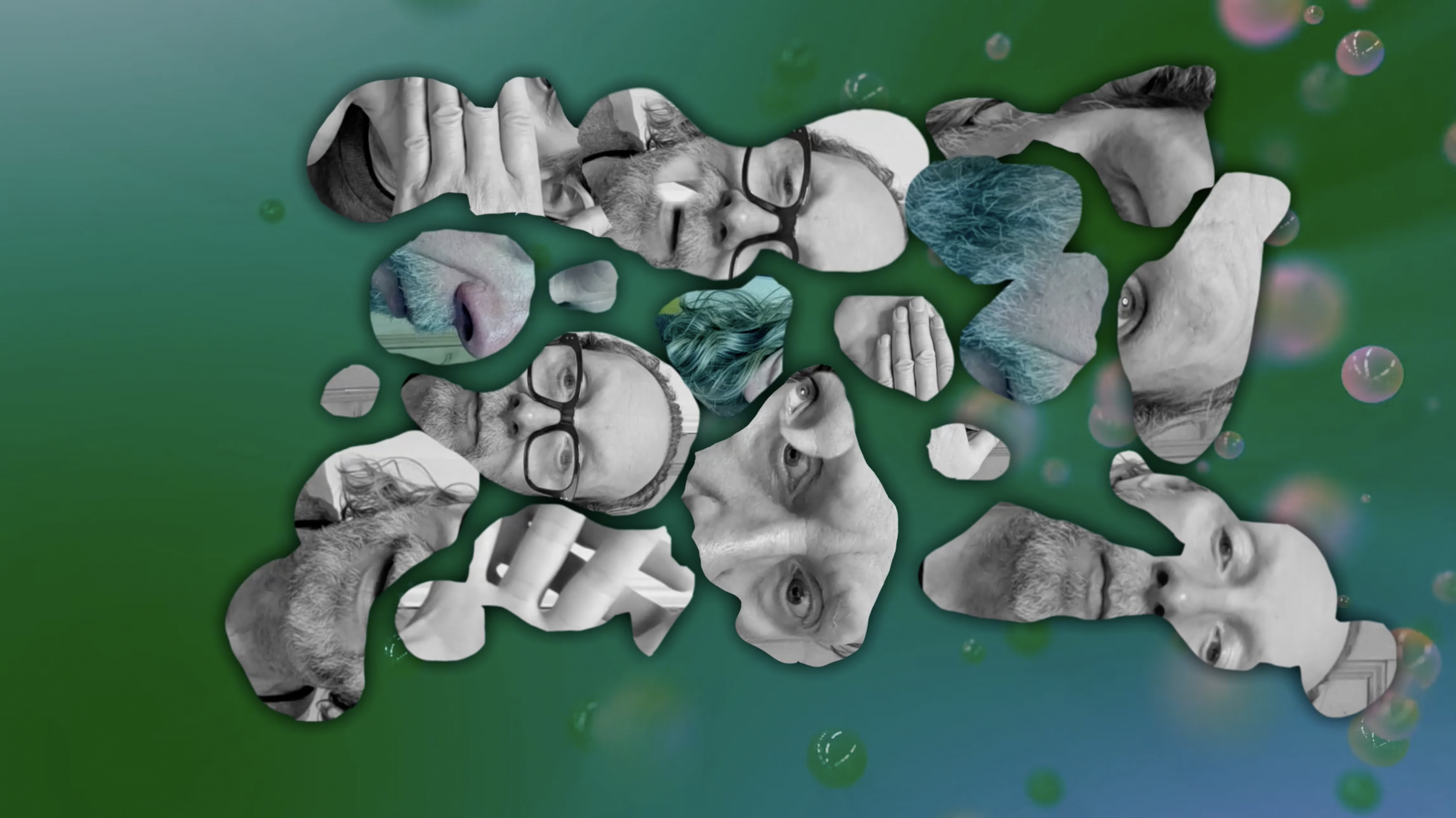
Homo telematicus explores how human presence is changing within networked space. Up to eight remote participants join the work at once, and their live webcam images are cut out, multiplied, scaled and woven into a single, constantly shifting composite. This assemblage is projected onto a sculptural, high-relief surface and filmed again, creating a recursive loop between bodies, screens and space, while layered audio adds a field of sampled and streamed sound. The piece extends Sermon’s long-standing interest in telematic exchange, in how encounters across distance can generate new forms of intimacy, play and collective authorship. With prerecorded material and the artist’s own live contributions, the boundaries between performer, audience and system become increasingly blurred. Sermon describes the work as ‘an experiment in distributed embodiment, co-creation and the evolving identity of the telematic human.’ It is first presented as a live performance at the exhibition opening, with contributions from long-time collaborators including Roy Ascott, Mike Phillips and Paul Thomas, and its documentation is then shown for the rest of the exhibition.
Artistic career: Paul Sermon
Artistic practice and research
Paul Sermon (UK, 1966) is a pioneer of telematic art who has explored how people meet and interact across networks since the early 1990s. He won the Golden Nica at Prix Ars Electronica in 1991, and works such as Telematic Dreaming, in which strangers share a bed through live video, have become landmarks of the field. He is Professor of Visual Communication at the University of Brighton.