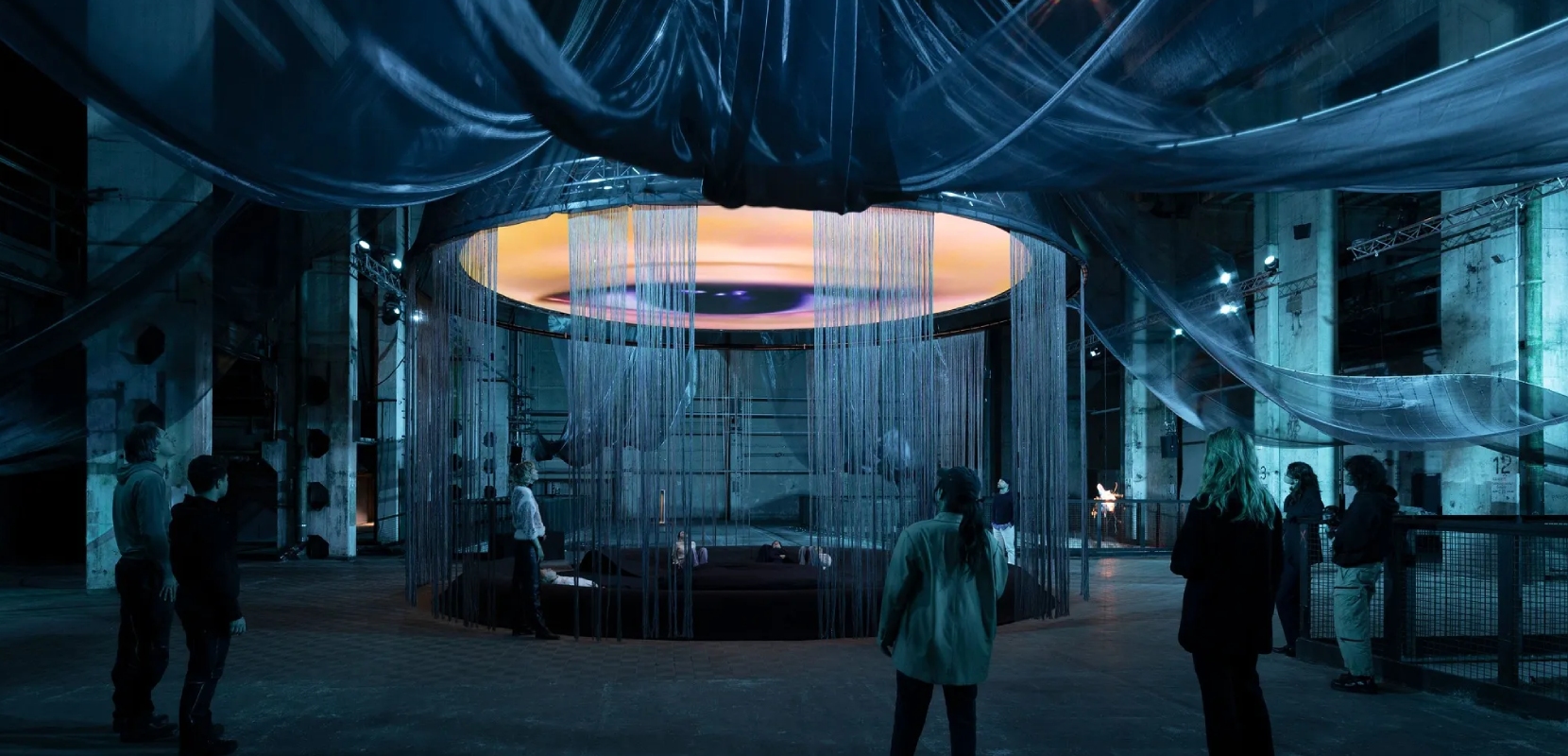
Ars Electronica is an international festival dedicated to art, technology and society, held annually in Linz, Austria, since 1979. Over its editions, it has served as a meeting point for artists, scientists, technologists and thinkers, exploring the intersections and ethical and cultural implications of the digital world. It has grown beyond the festival format into one of the world’s most influential platforms: a laboratory of ideas, a forum for debate and a space for experimentation and research that constantly challenges our understanding of the future and the role of digital creation in a world increasingly shaped by technology.
The 2025 edition, held from 3 to 7 September (watch a short reel here), introduced the provocative theme “PANIC yes/no”, confronting visitors with the dichotomy inherent in our relationship with today’s exponential advances. With 122,000 visits and participation by 1,472 artists, scientists and activists from 83 countries, the festival invited reflection on whether the appropriate response to artificial intelligence, climate collapse and social reconfiguration should be panic —understood as a collective alarm that drives strategic action. Through art installations, talks, performances and technological prototypes, this edition fostered an urgent dialogue on navigating a disruptive present with a critical perspective, seeking new paradigms beyond emotional responses or mere resignation.
At a time marked by geopolitical and ecological and social crises, the work of Artist Yolanda Uriz, "Chemical Calls of Care II" responds to the festival theme “PANIC – yes/no” by proposing care as a radical alternative to panic, encouraging mutual care through a horizontal, interspecies language based on reciprocity and empathy.
Presented and acquired by the NEWART Foundation, Chemical Calls of Care II is the second version of the project, the first version of which was presented at the Schemerlicht festival (Netherlands) 2024, curated by Siuli Ko.
This multidisciplinary installation explores audio-olfactory communication with plants through a speculative technological system, aiming to build horizontal relationships with the biosphere. It invites the audience to participate in chemical communication, a non-verbal language we do not fully understand. Flexible tubes and fans transmit chemical messages from plants to humans; conversely, visitors can send olfactory messages to plants using elements that promote their wellbeing. Gas sensors also capture atmospheric data and translate it into haptic sounds, helping humans understand it.
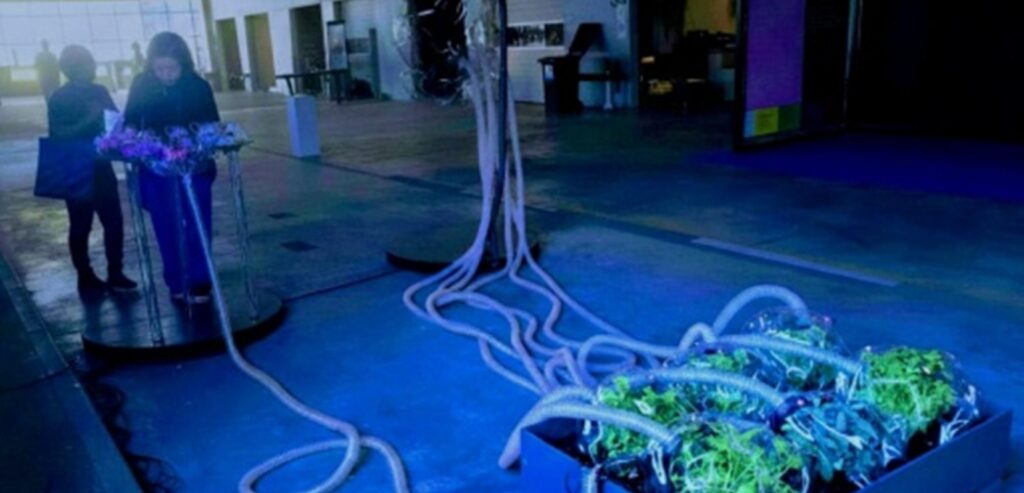
Artwork “Chemical Calls of Care II”, [2025], by Yolanda Uriz.