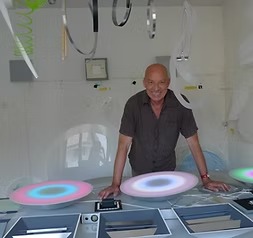
Basel, 1951.
Ulrich Muchenberger
L’any 1994 Ulrich Müchenberger will discover for the first time the phenomenon of l’art lleuger. The synergistic combinations of light and color, interchangeable or immobile, constitute the basis of the six works. In 1995, the artist presented his first dynamic lighting project. Many other works will follow, on a more diverse scale: from foundational artistic lighting projects to architectural complexes (for example, the National Museum of Copenhagen) to local lighting objects exhibited in galleries, finally to the artist’s native land, Basel. Müchenberger’s works, both static and dynamic, always have basic visual themes: the interaction between light and light in space and the optical effects of color combinations.
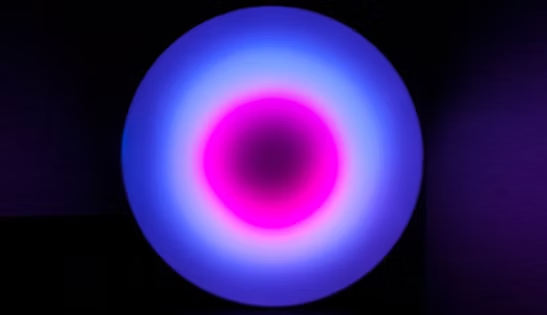
The lighting compositions are set in a strict geometric form, with the ordinary quadres: they change the six harmonies of color, intensity, brightness according to the program established by the author. The viewer is immersed in these images and landscapes that, in response to the artist’s desire, act on our imagination. The author explains of the series: “In dialogue between the two works, the consciousness of the viewer generates a response. This point between the emotional experience and its manifestation is the color, that is, the connection between the interior and the exterior.” Thus, each viewer acts on his own visual.
The color transitions in the artist’s works occur in a measured manner, at intervals of three and four minutes, which allows one to slowly consider all the optical transformations and combinations. Visiting the exhibition, it is also possible to appreciate the favorable arrangement of the objects carried inside, which is highlighted by the atmosphere of the “PROSVET” study.
http://umuchenberger.weebly.com/
Eye to Eye,
The exhibition presents several works from the Eye to Eye series. The lighting compositions are set in a strict geometric form, like normal paints: they change the six color harmonies, intensity, brightness according to the program established by the author. The viewer is immersed in those images and landscapes that, responding to the artist’s desire, affect our imagination. The author speaks of the series: “In dialogue between the two works, the consciousness of the spectator generates a response. This point between the emotional experience and the seva manifestation is what is the color, that is, the connection between the interior and the exterior. Therefore, each spectator acts on his own visual.