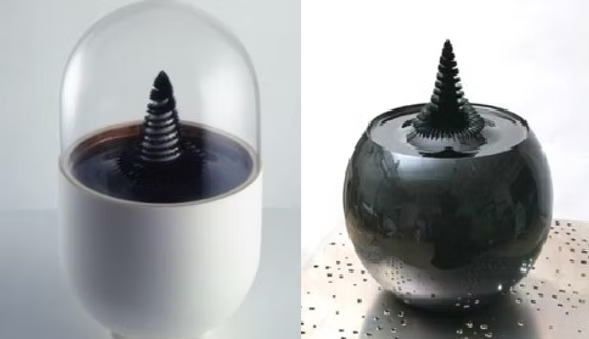
Shizuoka, 1970.
Sachiko Kodama
The surprising techniques developed in the six projects by the Japanese artist Sachiko Kodama are unprecedented in contemporary artistic practices, outside the field of digital arts.
The products are used by visitors to cause alterations in the magnetic fields of the magnets that cause the liquid to defy gravity and physics, acquiring three-dimensional shapes that change every second. A camera amplifies these movements and projects them on a screen, making it possible to appreciate in detail the richness and sophistication of the images produced.
These images, curiously, are not the same as all the strange ones: they remember synthetic images created by a computer, with six bright surfaces and the ability to change volume and shape in a second. This approach to a virtual aesthetic through a physical substance that we can observe from our point of view is one of the most intriguing aspects of this project.
Kodama has continued to develop the research into ferrofluids in subsequent works with Pulsate, an installation in which the magnetic liquid rests on a plate porcelain; Breathing Chaos, in the light of the light of the espelmes is the element that produces the movement of the fluids, or Morphotower, the most sculptural of the six projects, formatted by a ceramic cube with openings to supply the sinuous forms composed of liquid.
Kodama’s works have been shown in The exhibition “Machines&Souls” at the Reina Sofia Museum of Modern Art in Madrid and “Digital Creatures” in Rome in 2017.
Their work is an example of how scientific research can expand the expressive vocabulary of modern artists, allowing them to model physical reality and create images that we hope to believe that only possible in the field of imagination and sleep.
Kodama’s work is based on the study and manipulation of specific substances, ferrofluids, the properties of which are, at first glance, magical. Ferrofluids are liquids that, in their metallic context, have magnetic properties and respond to the proximity of the magnetic fields that vibrate and change shape.
With a computer system, Kodama controls the force of these magnetic fields in order to adjust both the response of the liquid Protrude, Flow, the project that will be donated to conèixer the seventh work, uses this technique to create a liquid sculpture that constantly changes shape between the astonished spectators. In this installation, between two large magnets a bag is placed that contains a solution of water, oil and ferrofluids. The liquid of the safata responds to the sounds that rep of its environment.
https://www.sachikokodama.com/en/works/
Morpho Tower white, Morpho Tower black, 2006
The first project “Protrude, Flow” will use its electromagnets. But, electromagnets occasionally prevent people from seeing the moving liquid. To solve this problem and simplify the work, we will discover a new technique called “Ferrofluid Sculpture”. This technique allows artists to create more dynamic sculptures with fluid materials. An electromagnet is used, with a ferrous core that is sculpted into a particular shape. The ferrofluid copperix the sculpted surface of the three-dimensional shape of ferro and the movement of the tips of the fluid is controlled dynamically to the surface by adjusting the power of the electromagnet.
The “Morpho Tower” series in 2006 will be the first realization of a “ferrofluid sculpture.” Figure 2 shows the spiral tower covered with ferrofluid punxes. A dempeus spiral tower on a plat supported the ferrofluid. When the magnetic field is reinforced by the voltage of the tower, ferrofluid spikes are generated to the bottom plate and the cap gradually increases, tremolant and rotates the voltage of the ferrospiral vora.
The movement of the spikes in the fluid is controlled on the surface by adjusting the power of the electromagnet. The shape of the iron cos is designed to be helical so that the fluid can migrate to the top of the helical tower when the magnetic field continues to strengthen.
The surface of the tower responds dynamically to its magnetic environment. When there is no magnetic field, the tower appears simply as a spiral shape. But when the voltant magnetic field of the tower is reinforced, punctures are generated in the ferrofluid; Simultaneously, the surface of the tower changes dynamically in a variety of textures: a fluid soft, a minute of molsa, les dents de tauró espia or a surface of ferro dur. The ferrofluid, in its soft black color, up to the top of the tower, is with a fractal and challenging gravity.
The tips of the ferrofluid are fan rotated by the power of the spiral, on either increasing or decreasing in size depending on the force of the magnetic field. With a computer, it is possible to control the transformation and movement of the shape together with its speed and rhythm. The rotation speed can be controlled without motors or gear mechanisms. It works both calmly; Simply control the gravity and a magnetic field.
Inspiration for the latest work of art comes from life and nature. The organic forms and geometry and symmetry observed in plants and animals are important inspiring factors when considering forms of cinematic art and potentially interactive ones. The behavioral movement of animals and other natural materials is also important. The rhythms of breathing in essers vius are an excellent metaphor for textures that change dynamically according to the weather. One of my main objectives is to apply these dynamic behaviors in computational interface design. (Public and private collections.)