Paul Thomas investigates the relationships between art, nanoscience and quantum theory, exploring how to visualise the boundaries between classical and quantum worlds.
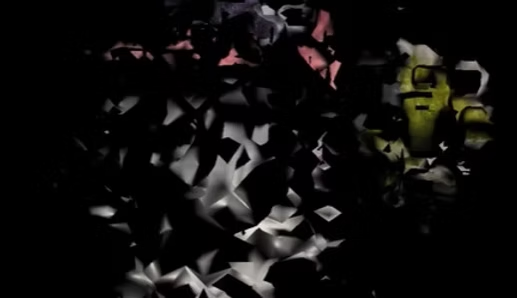
Quantum Chaos Set, made with Jan Andruszkiewicz, uses quantum-chaos data to visualise the conceptual boundary between classical and quantum worlds. The work explores uncertainty and difference as materials for artistic experience. Donated by the artist.
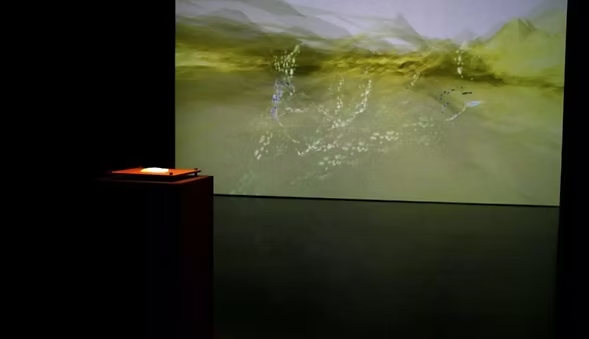
Quantum Consciousness connects quantum computing, consciousness and artistic expression. The artist’s voice reading Richard Feynman’s 1982 paper is related to data from an electron’s spin, transformed into image and sound. Collaborator: Kevin Raxworthy. Donated by the artist.
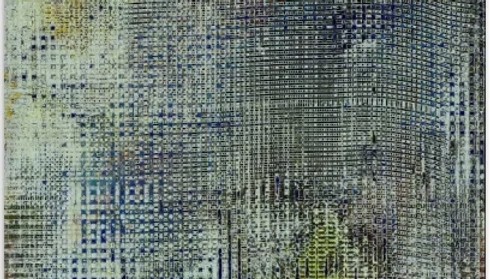
The Quantum Chaos series uses gestural painting and partial erasure to explore the relationship between classical chaos and quantum uncertainty. Visible and hidden layers turn abstract phenomena into a visual investigation. Donated by the artist.
Artwork in the collection
Nanoessence, 2010
About the artwork
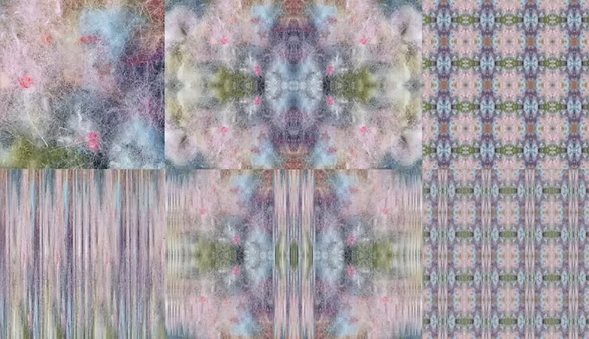
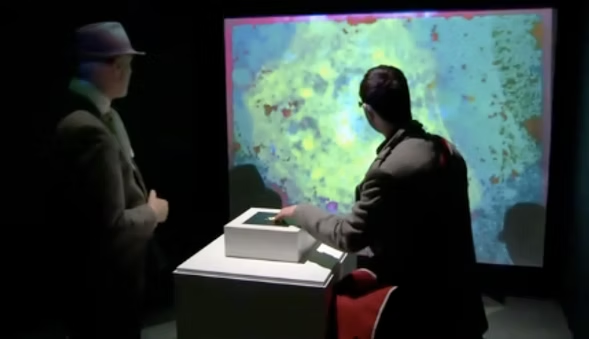
Nanoessence uses atomic-force microscopy data from living and dead skin cells. The visitor’s breath modifies images and sounds, proposing a sensory experience of life and death at a microscopic scale. Collaborator: Kevin Raxworthy. Donated by the artist.
Artwork in the collection
Multiverse, 2012
About the artwork
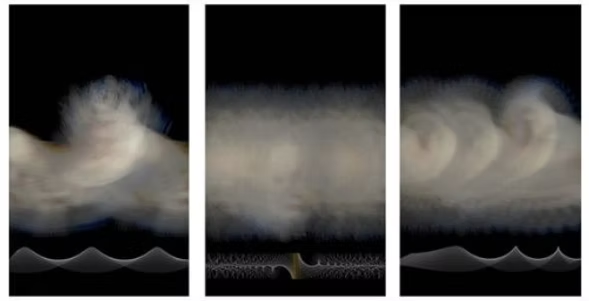
Multiverse transforms the viewer’s portrait into multiple versions using atomic-force microscopy data and Feynman’s ideas about photons and probability amplitudes. The installation offers an artistic interpretation of alternative realities. Collaborator: Kevin Raxworthy. Donated by the artist.
Artwork in the collection
Midas, 2007
About the artwork
Midas investigates contact between skin and gold using atomic-force microscopy data. Developed with SymbioticA and the Nanochemistry Research Institute, it translates material research into image and sound, using the myth of Midas as a metaphor for touch and transformation. Collaborator: Kevin Raxworthy. Donated by the artist.
Artwork in the Encyclopedia of New Media Art archive
Residual Space
About the artwork
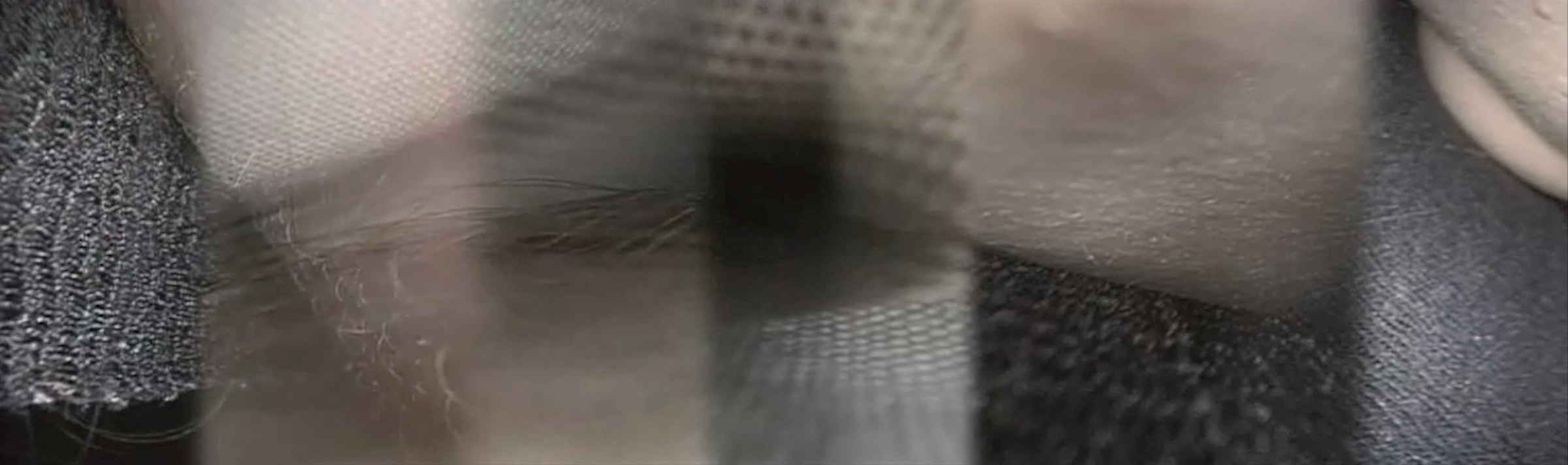
Using a laparoscopy camera, a medical device designed to see inside the body, Thomas filmed the hidden space between skin and clothing. This ‘residual’ zone is one we rarely notice: to feel it, the senses must turn back on the body and register the point of contact with our clothes. The body, he writes, ‘can’t articulate these spaces.’ In the video, transparency layers these images so that they merge into hybrid spaces, and the skin becomes a kind of screen between inner and outer realities. The work draws on Owen Barfield’s book Saving the Appearances, which suggests that before the scientific revolution ‘the world was more like a garment [people] wore about them than a stage on which they moved.’ For Thomas, the space between skin and cloth is our first, most intimate sense of space. A turning point in his practice, the project led him to ask how far our skin becomes part of what we wear, and opened the way to his later research into nanotechnology and quantum phenomena.
Artistic career: Paul Thomas
Career and projects
Paul Thomas develops a transdisciplinary practice connecting art, nanoscience and quantum theory. His career includes research and teaching at UNSW and founding directorship of the Biennale of Electronic Arts Perth. He collaborates with scientists including Andrea Morello to turn experimental data into visual and sonic experiences. His publications include Quantum Art and Uncertainty and Nanoart: The Immateriality of Art. The works in the collection were donated by the artist following conservation improvements within a programme supported by the Catalan Department of Culture.
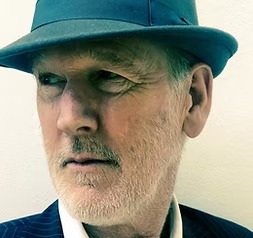
Paul Thomas (Australia, 1950) is an artist and researcher whose work explores how emerging technologies change our understanding of space, from the surface of the body to the nano and quantum scales. He is the author of Nanoart: The Immateriality of Art and Quantum Art and Uncertainty, and founded the Transdisciplinary Imaging conference series. He has taught at Curtin University and UNSW Sydney.