
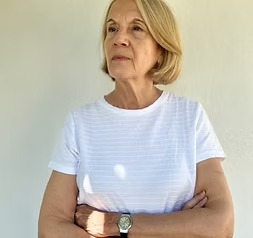
Lió, 1951.
Marie-France Veyrat & Jaime de los Rios
After returning to Grenoble, she is transferred to the province of Tarragona to face life and work. She is a versatile artist who shows a constant interest in researching and experimenting in artistic creation using different languages such as textiles, painting, three-dimensional, installations, digital compositions and land art. His work is based on visible experiences, records and journeys immagatzemats in everyday life that he transforms into real objects or virtual works. Each work represents a moment seen that is part of her life at some point in her life. He has been taught at the Triptych School in Reus. She is a founding member and current president of the jury of the ARCO-BEEP Electronic Art Prize. He has published three monographic catalogs along with six individual exhibitions.
Veyrat’s work has been exhibited at Art Sacré, Grenoble, Display Department, Nova York, Macula, Santa Cruz de Tenerife, Alicia Rey, Madrid, Àmbit, Barcelona, Lexington, Nova York, Artnet, L&B Contemporary Art, Atelier, Barcelona, WTC Eurostars Grand Marina Hotel, Barcelona, Caja Madrid, Ciudad Real, Roca Barcelona, Tom Maddock, Barcelona, Center de Lectura, Reus, Pilar Riberaygua, Andorra, Lleonart, Barcelona, Lisbon Penta Hotel Expo’98, Hotel Catalonia Berna, Barcelona, Anquin’s, Artloft, Antoni Pinyol, Reus, I Trobada Mundial de les Arts en petit format, Barcelona, Coves de Capçanes, Priorat, MAMT, Tarragona, Museu Salvador Vilaseca, Reus, among others.
Participated in individual projects i col·lectius, “UrSmile” www.ursmile.org Net Art, ARCO, 2008; “At 33 R.P.M.” Antoni Riera “The Autumn of Art”, Barcelona/Artmadrid, 2010/2011; “Campanar: T’estimo”, Center de Lectura Reus, 2002; “VeyrArt” digital project Gaudí Festes, Reus, 2002; “CADAF 2019” Jaime De los Ríos, Miami, USA; “Materials for a new plasticity” retrospective by Arnau Puig, Tinglado Tarragona, 2006; AAF Battersea, London, 2013; “Cares” Col·lecció Es Baluard/BEEP, Palma de Mallorca, 2019; “Plural Femení” by Dr. Antonio Salcedo, MAMT, 2016; “Art Urbà” Reus Catalan Capital of Culture 2017; AAF Milà’15; BEEP Collection “Aproximacions creatives” by Roberta Bosco and Stefano Caldana, Museu de Reus, 2017; “Sessió 09 Parlem de contemporani?” Convent of Arts d’Aleix Antillach, Alcover, 2019; ExPortArt – ImPortArt, 1st Biennal d’Art Contemporani, Port de Tinglado de Tarragona, 2013; Performance and Video “Looking for Veyrat” Diego Latorre, art studio, 2018; Forum “Survivències” Berger-Balaguer Caixa Penedès, Vilafranca del Penedès, 2003; Selected works from the modernist Casa Burés, Barcelona, 2019; “100 textiles. II National Exhibition of Contemporary Tapis, Finart 85, Madrid; Special mention for the 13th Saló Saint-Florent, France, 1990; “Marie-France Veyrat vs Manolo Millares” Torre Baró gallery, La Selva del Camp, 2006; Creative experiences “Parelles Artístiques” for mental health, 2018/2020.
Marie-France’s work is part of the following collections of Interior Design, Nova York, Urban Art, Almoster City Hall, Lisbon Penta Hotel, HP Madrid, Urban Art, Reus City Hall, Sorigué Foundation, Lleida, Grupotel Gran Via, Barcelona, Rovira&Virgili Universitat, Tarragona, Torre Vella, Salou, Cambrils City Council, Coves de Capçanes, Priorat, Fundació Josep Santacreu, Barcelona, WTC Eurostars Grand Marina Hotel, Barcelona, Port de Tarragona, Display Department gallery, New York, Fundació Caixa Penedès, Vilafranca del Penedés, Catalonia Hotel Berna, Barcelona, Dexter Design, Los Angeles, Califòrnia, Fortuny Theater Foundation, Reus, Meridiano Hotel, Hospitalet del Infante, Feliu-Sedó, Esparreguera.
Treball a la col·lecció: Urbetrònica
http://www.veyrat.org
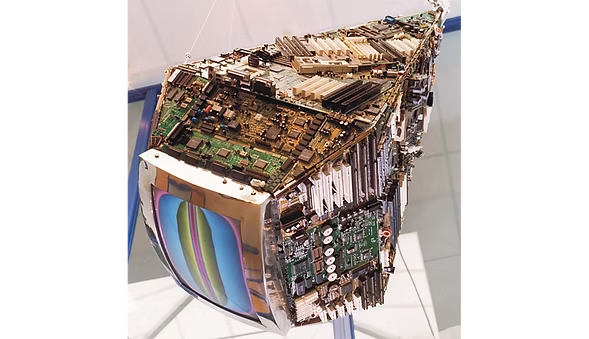
Urbetrònica, 1999
Urbetrònica is an audiovisual installation in the post-technological era with its machines and its processes symbolizing perfection in serial process chains, but this work is based on the aesthetics of glitch art created at the end of the 20th century. Així, an amalgam of names such as computer boards and machines and electronic devices that are currently obsolete are intentionally imperfect images to pose in crisis the apparent excellence of machines and computer systems that we are aware of. There, the error itself is possible in itself, it generates a new aesthetic of the poor or incorrect, passing from the mere image, audio or video to the most experimental programming. In short, works with digital defects become unique and singular works of art.
Also, once more present in Veyrat’s work, we discover in this piece the idea of architectural construction and recycling. The chaotic contemporary city appears for the first time in the forms drawn by buildings the culmination of which are fully illustrated in detail. Ens trobem davant el món urbà in action, those espai-temps that govern the technique and the human adventures, and that only in their failures fail in their ability to grasp the whole and the seva crua dimensió.