
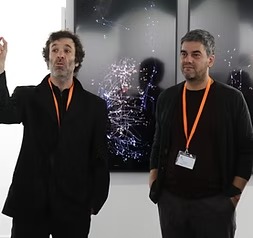
Mariano Sardón & Mariano Sigman, Bahía Blanca, 1968 / Buenos Aires, 1972.
Mariano Sardón & Mariano Sigman
Mariano Sardón is professor and professor of the Electronic Art Degree at the National University of Tres de Febrero, Buenos Aires, Argentina.
It will obtain the “Premi Konex” in the Visual Art Category 2012 awarded by the Fundació Konex, Buenos Aires, and the “Premi Experimentació in non-traditional media and video 2008” awarded by the Argentine Association of Art Critics. He is going to study Physical Sciences at the University of Buenos Aires.
Some exhibitions: Galeria Pilar Serra, Madrid, 2018. Galeria Artericambi, Verona, 2018. Artissima 2017, Galeria Artericambi. “Imatges de viatges; The New Pushkin Museum”, “Viva Arte Viva”, 57th Bienale di Venezia 2017. “Intuitions”, Pallazzo Fortuny, Bienale di Venezia, 2017. Ars Electronica Berlin, 2017. Ars Electronica Linz 2017, 2016, 2013. Pushkin Museum Moscou, 2016. Galeria Ruth Benzacar, 2016, 2012, 2004. BAPhoto 2017 Galeria Ruth Benzacar. AIPAD Photography Show 2014 Bryce Wolkowitz Gallery, NY. Press Miami Beach Bryce Wolkowitz Gallery, 2014. 11th Havana Biennial 2012. Bryce Wolkowitz Gallery NY, 2013, 2007. PROA Foundation, 2013 and 1999. Akademie der Künste Berlin, 2010. Museo de ArteMamba de Buenos Aires (2010), 2010, 2004. Ars Electronica México 2010. Fundación Telefónica Buenos Aires 2008 and Santiago de Xile 2011. Museum of Latin American Art of Buenos Aires (MALBA) 2003 and 2005. Between others.
Mariano Sigman grows up in Barcelona. He will obtain a master’s degree in physics from the University of Buenos Aires and a doctorate in neuroscience from New York. He is going to travel to Paris to investigate decision making, cognitive architecture and consciousness. In 2006 he founded the Integrative Neuroscience Laboratory at the University of Buenos Aires, an interdisciplinary group integrated by physics, psychology, biology, engineering, educational scientists, linguists, mathematicians, artists and computer scientists.
The laboratory has developed a focus. Empirical and theoretical in making decisions, with special attention to understanding the construction of trust and subjective beliefs. Many aspects of this research are based on the mining of data and computational resources on a massive corpus of human behavior (text, decisions…). Recently, new research has been progressively changed to understand the current knowledge of cervell and mentality that can serve to improve educational practice. Most of the projects carried out are carried out in schools throughout the country and are involved in this research on cognitive development to hundreds of thousands of children through the One Laptop Per Child (OLPC) framework.
Over the course of this career, many research interactions will be developed with representatives of different stakeholders areas of human culture, such as musicians, professional escac players, mathematicians, mages, visual artists and xefs. Various of these interactions will donate money to exhibitions presented to museums and galleries in Argentina, Mexico, Brazil, USA, Japan, New York and Austria.
Mariano Sigman is the only Latin American scientist who has been director of the Cervell Humà Project, and will be honored with a Human Frontiers Career Development Award, the national physics prize, the young researcher award from the “College de France”, the IBM Scalable Data Analytics award. He is a student of the James S. McDonnell Foundation.
The seventh work “The Wall of Gazes” will win the 14th edition of the ARCO-BEEP Electronic Art Prize
Treball a la col·lecció: El Mur de Mirades
http://marianosardon.com.ar/
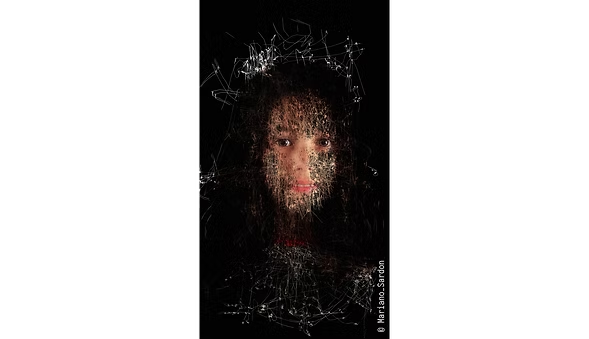
The Wall of Gazes, 2011
The Wall of Gazes consists of a screen on which visitors can see the images of the portraits revealed by the eye movements of many people simultaneously. The looks will be captured by an eye tracking device. About 100 participants are assured of a photographed image and the device will record their six glances for 15 seconds. The screen is connected to a computer and special software displays the scanned eye traces on a data base. The portraits are a composition in constant change, depending on the glances captured and shown on the programme.
The Mur de les Mirades aims to involve people in those parts of the face that are actually seen and those parts that say “it is not seen” while the attention is focused on an altre lloc in the portrait
Technological collaboration: Germán Ito. Development team: Cecilia Cisneros, Lucia Carvallo, Nahuel Rodrigues. Eye tracking data generated at the Muntref Center for Art and Science. National University of Tres de Febrero. Bons Aires.