Madrid, 1929-2021.
Luis Lugan
Luis García Núñez is a plastic artist who is difficult to classify, we cannot look for another painter-sculptor with similar connotations in the artistic panorama.
At the end of the 50s and the beginning of the 60s, the painting had a clearly geometric and constructivist character, in the works of that period, many of the works on cardboard, facing the sign with the name of García Núñez, later changed to his name by Lugan.
Thank you to them. Electronic knowledge was acquired during several years in the implementation of its work at Telefónica, and from 1967 onwards it began to be applied there, but only with a vision and a proposal for plastics, developing its first audiovisual work. tàctils.
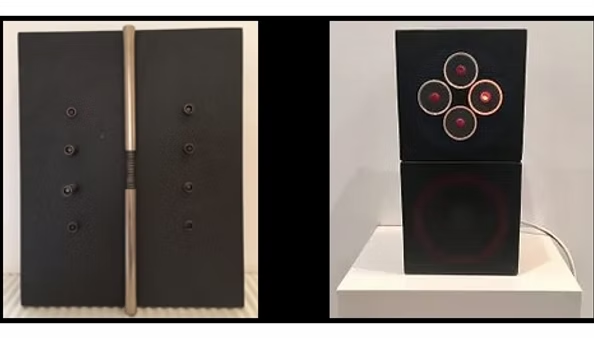
Lugan develops works in which it involves various senses at the moment: the hearing and the sight, the sight and the touch, the vegades fins and all the smell.
Són well conegudes the six sonorous aixetes or the six mans that give off heat in contact.
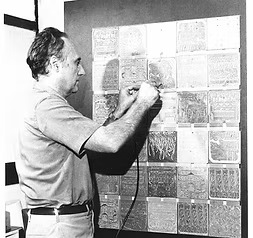
L’any In 1968 he joined a group of artists who for the first time used the computer as a tool to develop the six works, this experience was developed at the Computing Center of the Complutense University of Madrid in the Seminars on the Automatic Generation of Plastic Forms. . This group was formatted by José Luis Alexanco, Elena Asins, Tomás García Asensio, José Luis Gómez Perales, Eusebio Sempere, Abel Martín, José Mª Yturralde… What differentiated Lugan’s work from the rest of the components was that it was not interesting. in the programming, but the attention is going to focus on the different electronic parts of the machine, that is, the machinery.
In 1972 and at the time of the Trobades of Pamplona, Lugan will develop the related work Els telephones a l’atzar, which are telephones that are communicated randomly between different blocks of the city in a completely free way without passing through a “controlled” switchboard. This mateix will participate in the Venice Biennale and soon after the Sao Paulo Biennale.
He has participated in all the exhibitions dedicated to the Computing Centre, with the traveling exhibition “The Computing Centre, 30 years later” in 2003, which will tour the halls of the Elx Municipal Exhibition Centre, the University Museum. Alacant and the Museum of Contemporary Art of Ibiza. Two years later the Center Andalús d’Art Contemporani in Seville participates in the exhibition “Models, Structures, Forms”. Most recently, the exhibition dedicated to the MNCARS at the Pamplona Meetings and “From numerical calculation to open creativity. The calculation center of the University of Madrid (1968-1982)” Exhibition Hall of the Complutense Art Center. Madrid (2012) i Museu de la Universitat d’Alacant i Universitat Politècnica de València (2013).
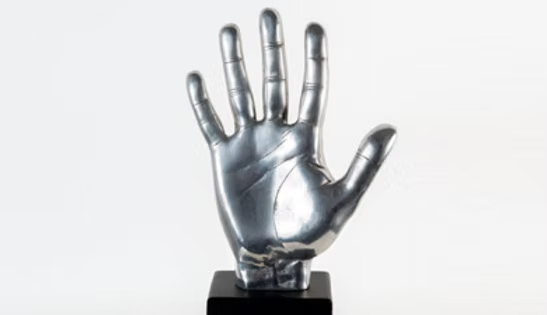
Artist's Thermal Hand, 1973
He will be the first Spanish artist who will think about real interaction with the viewer. It was believed that those who admire the pogues’s work without touching or feeling, something prohibited ends in any exhibition. In the midst of the Franco dictatorship, specifically in 1973, the Madrid artist delved into robotic techniques to create the Ma Tèrmica seva, the starting point of the Rostres exhibition.
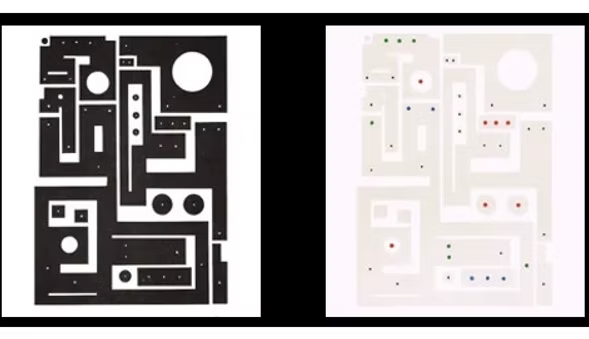
Sense title B/W, Sense title Color (silkscreen), 1973