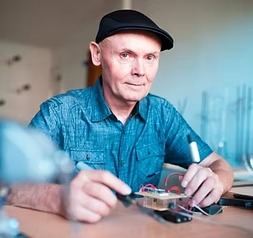
Meliana, 1955.
José Antonio Orts
Between science and art, physics and aesthetics, there is a link remote and disconnected from what happens in Meravello. That territory, which only a few curious people are willing to discover, is populated by the works of José Antonio Orts. Electronic art fish and sound sculptures that, rather than indolent romandre in a space, inhabit them. They preserve life when they are observats.
The study of this Valencian artist demonstrates. The walls, covered with electronic components and solar panels, give the welcome to a non-trained space that examines the fish for an explanation that all agglutinated. Prova d’això is the passadís, packed with imposing tubs of different lengths. Depending on these quests, Orts explains, the viewer can listen to different sounds or musical notes. Science is exact; art, pure emotion.
To the extent that art and music have always captivated the artist (who has a license in composition), electronics will be the discipline that will appear for the first time in life; Specifically, when he was just 10 years old. You are going to create circuits as a hobby, you don’t know exactly why. Gairebé three decades later, he knew perfectly: the lights of the six works are fed with ambient energy through solar panels. The sculptures xiuxiuegen or grounyeixen the steps, movements or gestures of the people who come to interact with them. The ball between the spectator and the work has just begun.
Rome, Paris, Berlin, Valencia. In these six sketches, the artist has a long and prolific career that has just won him the V Prize of the Fundació Cañada Blanch for his seventh work Trio de gotes de llum. “This is the first time that a work of electronic art has won this award. It creates a valuable precedent,” said Orts. But for now, for now, we serve as an excuse to connect with you and the new work. An opportunity that will not pass up.
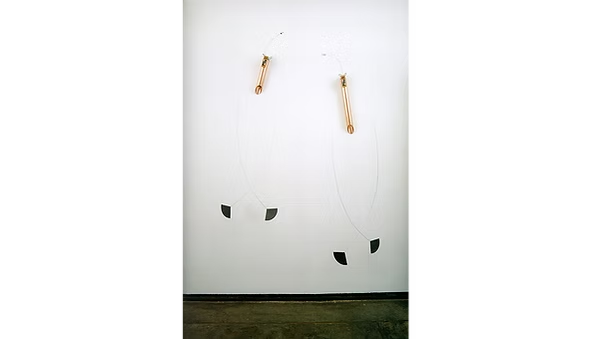
Treball a la col·lecció: – Duo Fa-la
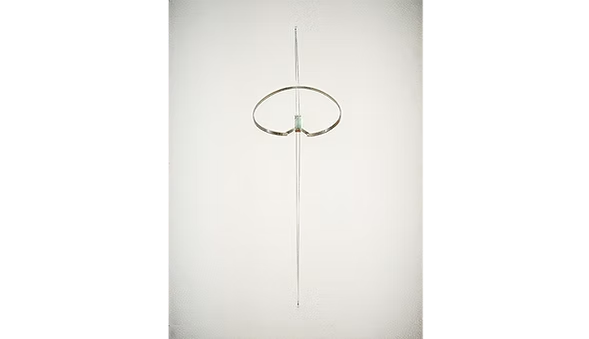
– Sin Titulo
https://joseantonioorts.com/
Duo Fa-la, 2004
Untitled, 2004
The installations, visuals and sounds, are made with electronic objects (sculptures) sensitive to the presence and movements of the viewer. The form of these objects has arisen from the function, so there is a very intimate relationship between the visual form and its, the light or the effect of the product. These electronic objects capture the presence of the spectator (the changes of lighting and the shadows that they project, or the small movements of air that they provoke when passing by) and transform these movements of the spectator into progressive variations of sound or lighting rhythm. rhythm.