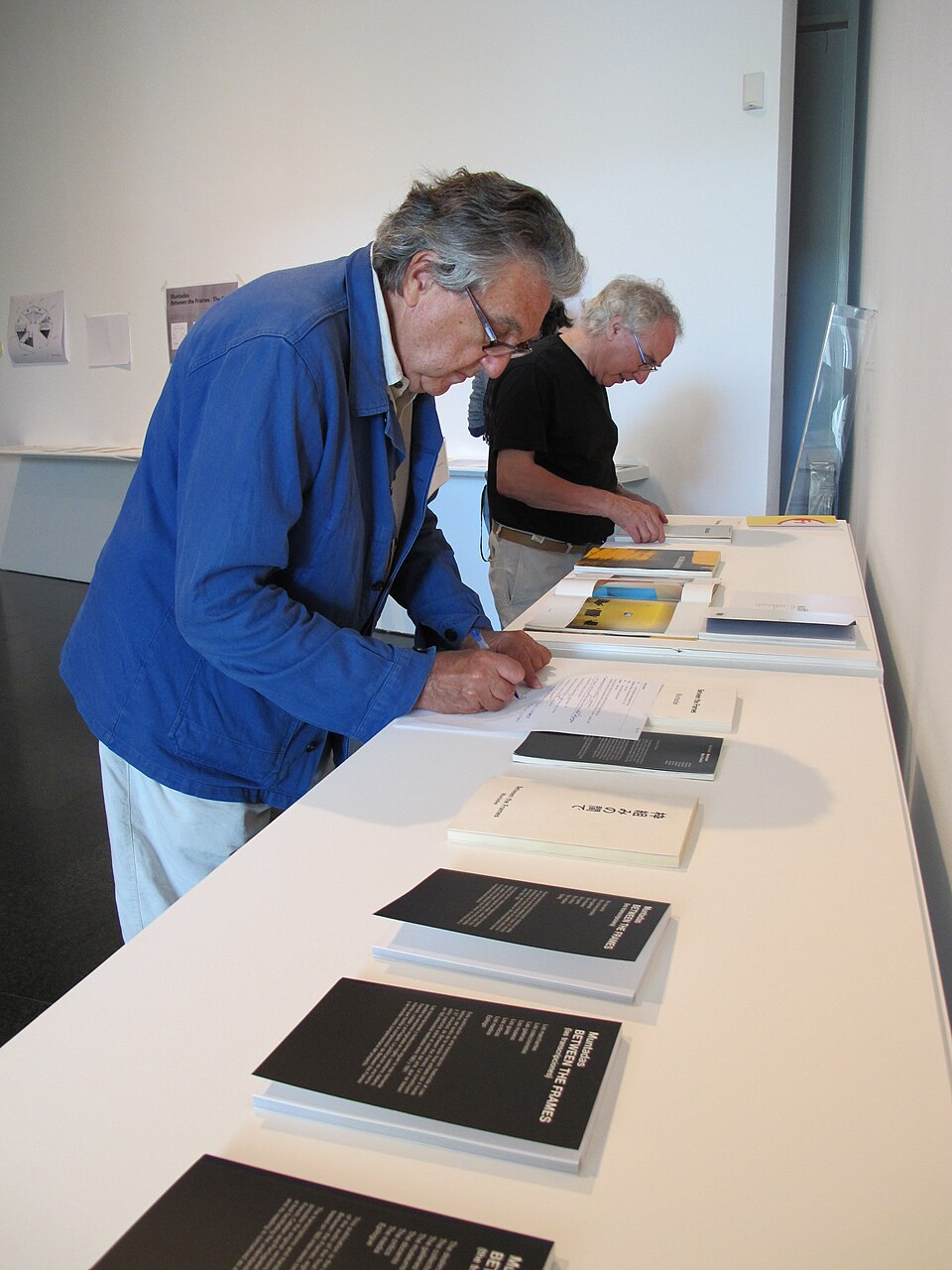
Barcelona, 1942.
Antoni Muntadas
Considerat one of the pioneers of media art and conceptual art in Spain, who for more than four decades has been working on projects in which he proposes a critical reflection on key issues in the configuration of contemporary experience.
The objective is to detect and decode the mechanisms of control and power through which the hegemonic gaze is constructed, exploring the decisive role that the communication mitjans have in this process. In his six works, which always have a clear processual dimension and in which he appeals directly to the participation of the spectators, Muntadas explores multiple supports, languages and discursive strategies, from interventions in public space to video and photography, from the publishing of printed publications to languages. d’Internet and new digital eines, from multimedia installations aimed at the implementation of multidisciplinary and collaborative research projects.
In the course of his career, Antoni Muntadas, who conceived the six works as “artifacts” (in the anthropological sense of the term, is to say, with quelcom that can be activated in different ways depending on the context and the moment in which it is present), has addressed questions with the changes in the relations between the public and the private, the naturalization of consumerist logic, the processes of cultural homogeneity imposed by globalization, the use of architecture as a way to legitimize political power and economic, the importance of communication mitjans. in the expansion of financial capitalism, the functioning of the artistic ecosystem or the use of the “altre” with a strategy of social control.
Treball to the collection: “Tasman Tiger: case study of the Museum of Extinction”
https://es.wikipedia.org/wiki/Antoni_Muntadas
"Tasman Tiger: case study of the Museum of Extinction" (2022).
Fidel to his personal language, allied to any current label, Muntadas presents a project about an extinct animal, the Tasmanian tiger, and also a technology in danger of extinction, holography, and a totally foreign installation in high-tech aesthetics, which most evokes l’encant dels antics museums of natural sciences. The work raises the debate on obsolescence and the eternal race to create new and sophisticated technologies, which ultimately generate a social rift that becomes increasingly deeper.
The work recreates a room in a natural history museum, with three display cases and a 1.5 m. hologram, which will have to be produced in Lithuania, since it is the only one capable of representing these dimensions. The display cases contain photographs of the research carried out and some moving images on tauletes; An other sideboard shows DNA studies on how animals disappear, including the Tasmanian tiger, one of the most studied cases; And there is a third sideboard with Marxandatge, which is the one that kept the Tasmanian tiger alive in popular culture (samarretes, beers, coasters, postcards…). They are elements that allow us to keep Tasmania very present.
https://www.arshake.com/en/antoni-muntadas-and-the-tasmanian-tiger-at-ars-electronica/