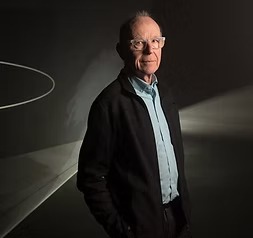
Saint Paul's Cray, 1946.
Anthony McCall
McCall is connected with the six installations of “solid illum”, a series that began in 1973 with “Line Describing a Cone”, in which a volumetric form composed of projected illum slowly evolves in three-dimensional space.
Occupying a space between sculpture, cinema and drawing, the historical importance of his work has been recognized in exhibitions such as “Into the Light: the Projected Image in American Art 1964-1977”, Whitney Museum of American Art (2001-2002); “The expanded screen: actions and installations of any six and seven years”, Museum Moderner Kunst, Vienna (2003-2004); “The Expanded Eye”, Kunsthaus Zurich (2006); “Beyond the cinema: the Art of Projection”, Hamburger Bahnhof, Berlin (2006-2007); “The cinema effect: Illusion, Reality and the Projected Image”, Hirshhorn Museum, Washington DC (2008); i “On Line”, Museum of Modern Art (2010-2011).
McCall’s work has also been exhibited, among others: Center Pompidou, Paris, Tate Britain, London, SFMoMA, San Francisco, Serpentine Gallery, London, Hangar Bicocca, Milà, Moderna Museet, Stockholm, Serralves, Porto, Hamburger Bahnhof, Berlin, Kunstmuseum St Gallen – Lokremise, Eye Film Museum, Amsterdam and Lugano Arte e Cultura.
The work is represented in numerous collections, among others, Tate, London, MoMA, Museum of Modern Art, New York, Museum für Moderne Kunst, Frankfurt, MACBA, Museu d’Art Contemporani de Barcelona, Whitney Museum of American rt, New York, SFMoMA, Center Pompidou de San Francisco, Paris, Moderna Museet, Stockholm and Hirshhorn, Washington DC.
Treball a la col·lecció: “Face to Face II”
http://www.anthonymccall.com
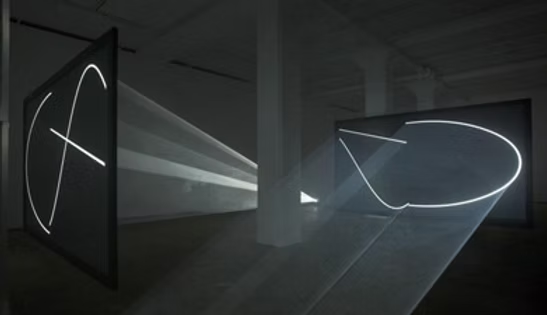
Face to Face II, 2013
A video installation formed by two light projections on two screens, which require the presence of the public to enjoy life. Through light, shadow and smoke, the artist generates an ephemeral space, giving the visitor the sensation of creating solid walls of light, which transform both the contact of the objects, creating always new geometries and unpredictable alterations of the architectural space.
Amb the support of :