NEWART centre – Centro de arte digital y tecnológico en Reus

Santander, 1976.

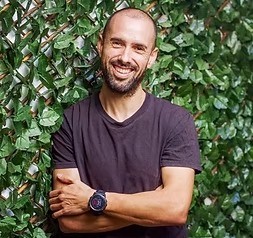
Alex Posada

Alex Posada is a digital creator, professor and researcher in the field of interaction, digital art and our new mitjans.

He is a multidisciplinary artist who works at the intersection between art, science and technology through research and constant development of his own systems and networks.
He is also dedicated to teaching in different higher studies, masters and postgraduate studies and has directed various workshops dedicated to art and technologies interactives to different countries.

After finishing his Telecommunications Engineering studies at the University of Cantàbria, in 2002 he will move to Barcelona, where he will train in multimedia art and will begin to work on interactive design and electronic art projects.

He will be Hangar served as director of the interactive laboratory between 2006 and 2015.
He currently directs MID Studio. Founded in 2012, it is one of the pioneering studios in electronic art projects in Barcelona in the last 10 years.

Their projects have been exhibited at the Brazilian Olympic Games, Phaeno Science Center, Ars Electronica, Kinetica Arte Fair de London, Kernel Festival de Milà, Mapping Festival, LEV Festival, Sonar Festival and Art Rock Festival between d’altres. The studio has also developed projects for museums and cultural centers such as the Picasso Museum, CCCB or MNAC of Barcelona, Círculo de Bellas Artes of Madrid or Roca Gallery Barcelona.

He is also an active entrepreneur and co-founder of some start-ups in the technological field such as Smart Citizen, OvalSound and Broomx Technologies.

Paral·lelament, develop projects with an independent multimedia producer and col·labora with other artists and col·lectius.

Treball a la col·lecció: “The Particle v2”
https://thecreative.net/alex-posada#

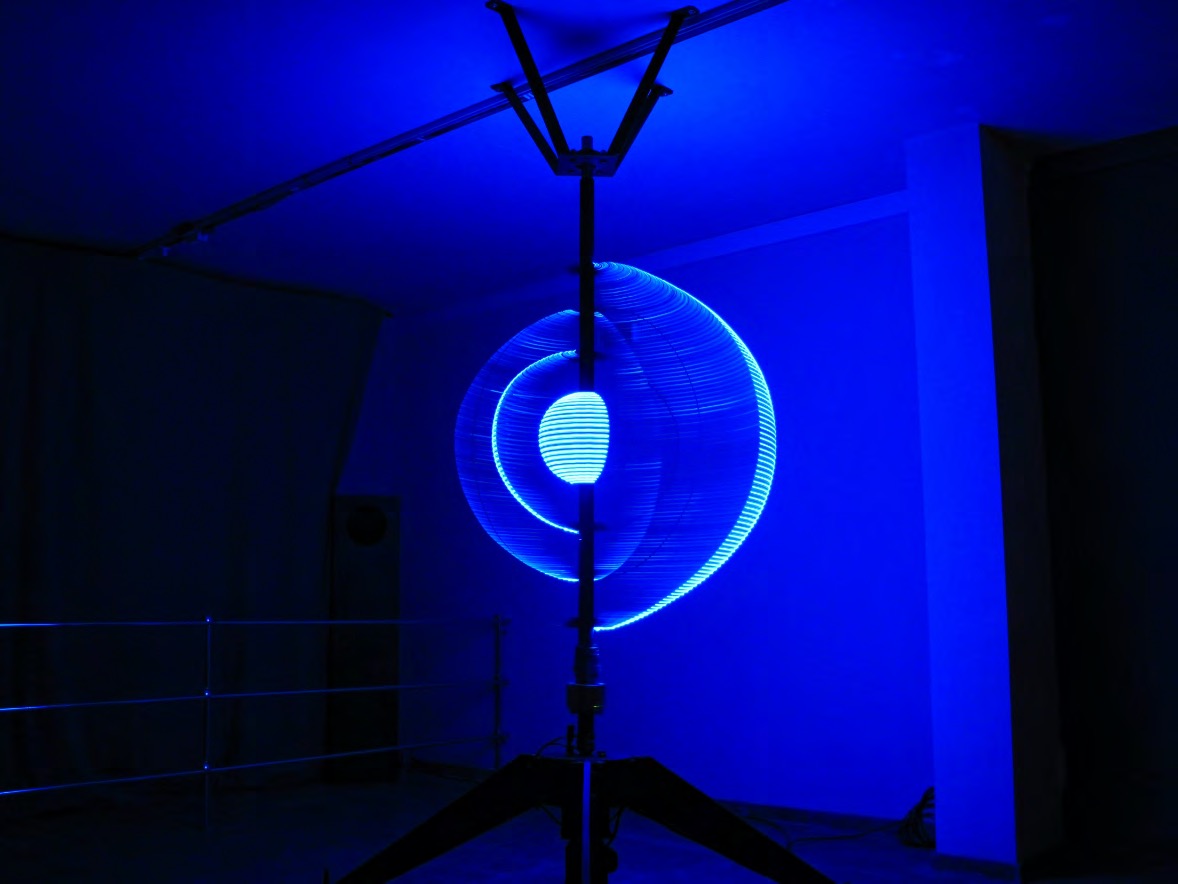
“The Particle v2”, 2022

It is a kinetic sculpture that experiences both light, sun and movement. Formally, the piece is a work of generative art, abstract algorithms and mathematical functions that are interpreted and visualized through lighting and its modulation to space and continuously changing the atmosphere and the perception of space. The translucent film created from the moving light is visible, creating shape and volume collected for visual effects that define the spatial structure of the object. The shape of the light results from the movements of each of the six 4 rings, rotating at high speed, and its neix of the materials that govern these behaviors.
The result is the creation of three-dimensional structures of light. These forms can aturate, rotate and move more quickly or more slowly creating beautiful synesthetic effects. The technique used is the perception of apparent movement, that is, it is obtained from the observation of sequences of images fixed by successive projects. This visual effect, also referred to as persistence of vision (POV), is the theoretical capacity of the eye (or retina) to retain the last image that it has seen, since an object continues to feel but faces that it has not physically followed.

Following the evolution of the artist’s work in the field of the cinematic sculptures of light and so, and the research work in the field of synesthesia, light, music, light technologies and the creation of generating audiovisual continguts; This new evolved version of a previous existing prototype of the artist is presented, with “The Particle” (2010).
The object is now a space of sensory and synesthetic experience, an organ with its own internal resonance that does not leave the visitor indifferent.

https://www.youtube.com/watch?v=ND5VeRpkP78