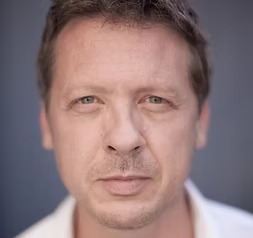
Paris, 1966.
Eric Vernhes
After completing his architecture diploma taught by Paul Virilio, Eric Vernhes began working in film production at the expense of Anatole Dauman at Argos Films. Dauman continues inviting Vernhes to write some of his first fiction and documentary projects. Among them, “Le théâtre amateur”, selected by the Cinémathèque Française for its cycle “Cent anys de curtmetratges”, appeared with the large film “Le Grand Projet”, winner of the Michel d’Ornano award at the 1996 Deauville Film Festival.
Llançant the production company “Les Productions Polaires”, Vernhes assumes cinema as a central art form and is presented in all its six facets, from script writing and production to directing and creating it. Looking for more intuitive approaches to the audiovisual mitjà, we turn to experimental video, implementing digital tools that condense the editing process, the rendering of the sound image and the projection into a single act. In an improvised music company with Serge Adam, Benoit Delbecq, Marc Chalosse and Gilles Coronado, Vernhes creates performances that generate digital images and music simultaneously. These performances are interactive or depend on a unique improvisational production of images created by a specific programming interface. The aim of this work is to formulate a new cinematographic language, dictated only by intuition and the present moment.
At this time Vernhes also worked on theatrical projects, where the imagery is integrated from the first phases of writing (in collaboration with Irène Jacob, Jean-Michel Ribes…), he also appeared in some projects for the rock scene (amb Rodolphe Burger, Alain Bashung…).
Starting in 2008, he began to work on installations and audio-cinematic installations, the performances of which are programmed with self-generating, interactive or hybrid logic. It thus develops a complete artistic signature, decidedly humanist. Extrets of its technical context, the digital processes used by the artist tell a timeless narrative inspired by literature and philosophy. With its sophisticated aesthetics and the use of rare and high-quality materials, Vernhes fish transcend the technical engineering aspects of its programming, in order to explore the human gest of creation. The artist has also constructed various anthropoid fish, the self-propelled structures of which are fused with the conscious perception of the viewer to create a symbiotic performance.
Eric Vernhes has been exhibited in various venues, centers and international art foundations, his work is part of various collections and private foundations, such as for the Hermès Foundation, the Frankel Foundation and the Artphilein Foundation. He is also a professor of art of our mitjans.
Treball a la col·lecció: De Notre Nature
https://www.ericvernhes.com/
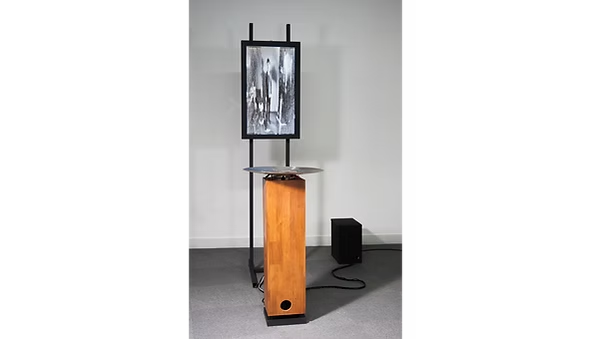
From Notre Nature, 2013
De Notre Nature is inspired by book II of «De rerum natura», by Lucrècia. This poem in Latin, written in the 1st century BC, is a translation of the atomistic doctrine developed by Epicur two centuries ago. It calls “àtoms”. These atoms are moved randomly to the buit and can be combined to form aggregates of matter that can embody both a home and any object.
In this materialist framework, Lucrècia proposes the concept of “clinamen”: a deviation, a spontaneous and random deviation of the atoms of nature vertical drop to the buit, which allows the extraction and generation of matter. From this atomic mechanics, Epicur deduces the absence of divine determinism and the proof of the existence of our light.
Eric Vernhes represents this cosmogonic vision through an installation formed by a column crowned by a golden safata that contained bowls and a screen that looked a few moments steps of the column. As the viewer sits down, the story I told on the marbres – a representation of the atoms of the Epicurus doctrine – begins to oscillate. The bowls surround and xoquen between them, generating a sound “one”. Simultaneously, a fragile image of the viewer appears on the screen as if generated by the movement of the «particles» of the safata.