
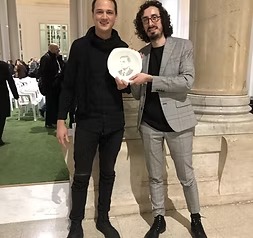
Albert Barqué Duran & Marc Marzenit
Albert Barqué-Duran, Lleida, 1989, & Marc Marzenit, Barcelona, 1983.
Albert Barqué Duran and Marc Marzenit connect artistic research, creative technologies and music in projects exploring audiovisual experience.
Artwork in the collection
Vestibular_1
About the artwork
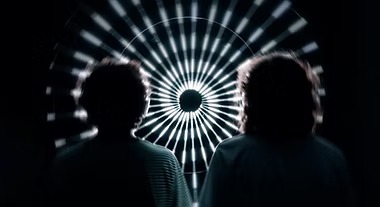
VESTIBULAR_1 is an immersive audiovisual installation that invites the public to walk inside a structure of the vestibular system. Specifically, the installation induces illusory sensations of self-motion by temporarily altering the audience’s vestibular functioning through specific patterns and configurations of audio and light stimuli.
Artistic career: Albert Barqué Duran & Marc Marzenit
Artistic practice and research
Albert Barqué-Duran, PhD, is an artist and researcher. Professor of Creative Technologies and Digital Art at the University of Lleida and Honorary Research Fellow at City, University of London.
Career and projects
Albert obtained his PhD and postdoctoral degree in cognitive sciences at City, University of London, and has been a visiting postgraduate researcher at Harvard University and the University of Oxford. His artworks and performances are inspired by his research and combine new media art techniques, AI, computational creativity, data, experimental electronic music, and classical fine arts methods such as oil painting and sculpture, to reflect on universal themes, knowledge, digital culture, and futures.
He leads disruptive projects at the intersection of art, science, and technology with the aims of: finding new formats for generating artistic and scientific knowledge; reflecting on contemporary and futuristic themes and their cultural implications; and creating powerful experiences to push the limits of human perception. Considered one of the 64 “Cultural Activists” in Europe during 2019 by We Are Europe, and internationally awarded with the “Re:Humanism Award”, the “We Are Equals – MUTEK Music Academy”, the “Art of Neuroscience Award” and the “International City of Lleida Award”, Albert has exhibited and performed at Sónar+D (Barcelona), Ars Electronica (Linz), ZKM (Karlsruhe), Creative Reactions (London), Cricoteka (Krakow), Albumarte (Rome), SciArt Center New York, IGNITE Fest (Medellín), Mobile World Congress (Barcelona), and Ming Contemporary Art Museum (Shanghai), among others.
Marc Marzenit is an audio engineer, composer, music producer and DJ with many years of experience touring worldwide. He has performed in places such as London, Paris, New York, Los Angeles, Argentina, Mexico, Australia, Canada and Asia, to name just a few. In addition to his profile as an underground musician, he also created shows such as “Suite on Clouds”, a 3D mapping performance featuring 8 violinists, 1 harp, symphonic percussion, synthesizers and a grand piano.
These projects are based on his classical training and showcase his integrated vision of electronic music: combining acoustic, analogue and digital instruments within the same performance. He is currently a lecturer in “Music and Sound for Interactive Experiences” at ENTI – University of Barcelona; and the founder of Aulart. Work in the collection: Vestibular_1