
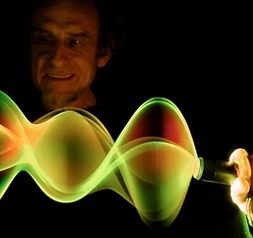
Paul Friedlander
Manchester, 1951.
Paul Friedlander investigates light as a sculptural material, using technologies and processes that give it shape and volume.
Artwork in the collection
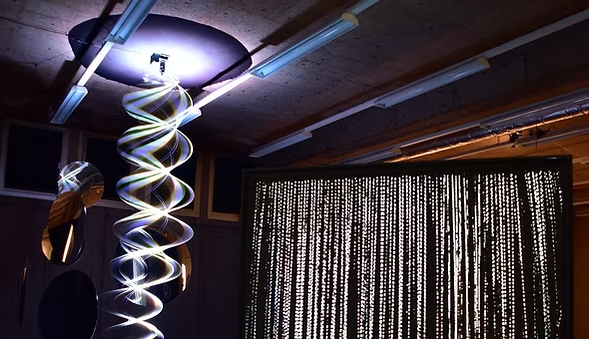
Dancing Waves - Tycho;test one, 2018
About the artwork
This is the latest work by this creator, the installation Tycho; Test One. The piece consists of a luminous concrete monolith, a new material developed by Eurecat for the company Escofet, with which the artist has been able to work for the first time.
Artistic career: Paul Friedlander
Artistic practice and research
For over two decades, she has been researching all kinds of technologies and processes to transform light into a malleable and flexible material capable of taking on any shape and volume.
Career and projects
For over two decades, he has been researching all kinds of technologies and processes to transform light into a malleable and flexible material capable of taking on any shape and volume. Friedlander’s “kinetic light sculptures” are indebted to the work of other major figures who preceded him in light and kinetic art, from László Moholy-Nagy to Flavin and Turrell, making use of computerized lighting control systems to emphasize the sense of immateriality and dynamism in his sculptures.
Like many other creators who have developed their careers at the intersection of art, science, and technology, Friedlander situates his work within a hybrid space. On one hand, his works are rooted in the broad tradition of 20th-century kinetic art, which he openly embraces. At the same time, the British artist cannot separate his career from the field of large-scale stage lighting, where he began his trajectory and which has played a decisive role in the development of lighting technology in recent decades.
The formal legacy of the former and the technical procedures of the latter have enabled Friedlander to develop a body of work that is instantly recognizable. Friedlander’s work is also an example of how scientific research can expand the expressive vocabulary of contemporary artists, allowing them to shape physical reality and create images that we might previously have thought possible only in the realm of imagination and dreams. Paul Friedlander’s works have been exhibited at various ArtFutura festivals in Barcelona, Buenos Aires, Madrid, and Montevideo, as well as in the exhibition "Machines&Souls" (Museo Nacional Centro de Arte Reina Sofía, Madrid, 2008) and "Digital Creatures" (Rome, 2017).
Although works such as The Wave Equation or The Energy Core are not strictly holograms, what the viewer encounters are large incorporeal forms in motion, suspended in the air, which, when illuminated, give light a three-dimensionality that we are not accustomed to perceiving in immediate physical space. In their titles, Friedlander’s kinetic light sculptures often reference different aspects of modern science, from quantum physics to string theory.
However, their aesthetic construction and the way audiences experience them inevitably evoke the spiritual and the magical. Ultimately, the physical elements on which Friedlander’s sculptures are based are concealed behind the mystery of a simple yet striking optical effect. Works in the collection: – Tycho;test one – Dancing Waves