
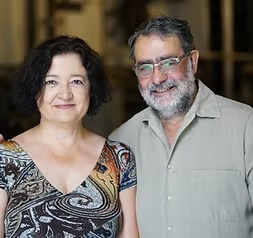
Joan Fontcuberta & Pilar Rosado
Joan Fontcuberta, Barcelona, 1955 and Pilar Rosado, Sant Boi del Llobregat, 1965.
Joan Fontcuberta and Pilar Rosado share an investigation into art, images and technology that has led to a series of collaborative projects.
Artwork in the collection
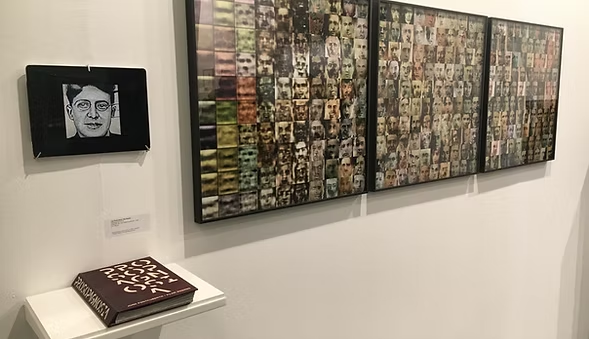
Prosopagnòsia, 2019
About the artwork
Prosopagnosia is an artificially created speculation on the dialectics of facial recognition and the surveillance of celebrity portraits in historical archives. Generative adversarial networks (GANs) have been used, which are deep neural network architectures composed of two networks that compete against each other (hence the term "adversarial"), to create portraits that have never existed. Ian Goodfellow and other researchers at the University of Montreal introduced GANs in a paper in 2014.
The potential of these models is enormous because they can learn to imitate any dataset; that is, GANs can be taught to create unsettling worlds similar to our own in any domain: images, music, speech, or prose.
Artistic career: Joan Fontcuberta & Pilar Rosado
Artistic practice and research
Joan Fontcuberta and Pilar Rosado have their workspaces at the Roca Umbert Arts Factory in Granollers, Barcelona. This proximity allowed them to discover shared concerns about art and technology, which led to their collaboration on various projects.
Career and projects
Joan Fontcuberta has developed both an artistic and theoretical practice focused on the conflicts between nature, technology, photography, and truth. He is a self-taught artist, and his background lies mainly in communication and social sciences. From this theoretical starting point, his work has focused on the changing nature of images. However, beyond their aesthetic qualities, images are understood as social and historical constructions that provide models for the real world and enable human interaction.
Pilar Rosado is an artist, teacher, and researcher. She holds a degree in Biology and a PhD in Fine Arts, and has published several essays on the application of computer vision models for the analysis of large collections of abstract art images, offering alternative points of view for reflection and questioning the conventions of our gaze. In her artistic practice, she explores political issues that can be approached through images and that involve machine learning technologies, such as the management of information in the visual archives of the future, the revision of collective memory, or artificial creativity.
Their work "Prosopagnosia" won the 15th edition of the ARCO-BEEP Electronic Art Award. Work in the collection: Prosopagnosia