

Miami, 1960
Mark Amerika
A pioneer in applying 3D animation to his work, Manu Arregui’s practice focuses on reflecting on body politics and advocating for “non-normative” identities. Always from a critical standpoint, his pieces—rich in lyricism—merge virtuosity and experimentation. At the same time, without abandoning irony, the artist examines the increasing virtualization of our lives and the future of art in this post-contemporary era.
Considered a pioneer of net.art, since the 1990s he has developed a solid career grounded in experimentation with new technologies and media.
He has held solo exhibitions at venues such as the Denver Art Museum, London’s Institute of Contemporary Arts, and the Walker Art Center in Minneapolis.
His work has been shown in more than 100 international group exhibitions across five continents and, in 2009–2010, the National Museum of Contemporary Art in Athens hosted the exhibition UNREALTIME. Other exhibitions were presented at The Power Plant (Toronto), the Eli and Edythe Broad Art Museum, the Museum of Contemporary Art Denver, ZKM, and the Montreal Biennale.
The Abandon Normal Devices festival in the United Kingdom, together with the London 2012 Olympics, commissioned the large-scale transmedia artwork Amerika, Museum of Glitch Aesthetics [MOGA], which was shown in a solo exhibition in Manchester.
He is the author of numerous books, including the cult novels The Kafka Chronicles (FC2/University of Alabama Press, 1993) and Sexual Blood (FC2/University of Alabama Press, 1995), as well as two books documenting his experiences as one of the earliest digital artists to investigate the Internet and remix culture: META/DATA: A Digital Poetics (The MIT Press, 2007) and remixthebook (University of Minnesota Press, 2011). In 2022, Amerika published My Life as an Artificial Creative Intelligence (Stanford University Press), a collection of artist writings focused on his experiments with artificial intelligence.
https://markamerika.com/
https://www.youtube.com/watch?v=p9feoVWv7H0
He has held solo exhibitions at venues such as the Denver Art Museum, London’s Institute of Contemporary Arts, and the Walker Art Center in Minneapolis.
His work has been shown in more than 100 international group exhibitions across five continents and, in 2009–2010, the National Museum of Contemporary Art in Athens hosted the exhibition UNREALTIME. Other exhibitions were presented at The Power Plant (Toronto), the Eli and Edythe Broad Art Museum, the Museum of Contemporary Art Denver, ZKM, and the Montreal Biennale.
The Abandon Normal Devices festival in the United Kingdom, together with the London 2012 Olympics, commissioned the large-scale transmedia artwork Amerika, Museum of Glitch Aesthetics [MOGA], which was shown in a solo exhibition in Manchester.
He is the author of numerous books, including the cult novels The Kafka Chronicles (FC2/University of Alabama Press, 1993) and Sexual Blood (FC2/University of Alabama Press, 1995), as well as two books documenting his experiences as one of the earliest digital artists to investigate the Internet and remix culture: META/DATA: A Digital Poetics (The MIT Press, 2007) and remixthebook (University of Minnesota Press, 2011). In 2022, Amerika published My Life as an Artificial Creative Intelligence (Stanford University Press), a collection of artist writings focused on his experiments with artificial intelligence.
https://markamerika.com/
https://www.youtube.com/watch?v=p9feoVWv7H0
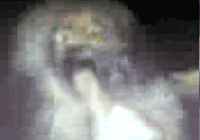
Cookie Monster (Gloyaglitch 1) [MOGA], 2005-2006
It was created between 2005 and 2006, when Mark Amerika began experimenting with low-quality images captured with a mobile phone camera. He recorded details of major works from art history, such as Saturn Devouring His Son, one of Goya’s Black Paintings.
The animated GIF is a format inherent to today’s popular culture, situated between photography and video, where image quality is the least relevant factor. In fact, these images were captured by the artist during the years when mobile phones with video cameras became widely popular—something that transformed the way we communicate and that some creators incorporated into their artistic practices, as has happened with every communication technology that has emerged in recent decades.
The GIF becomes a perfect vehicle for telling a short story, conveying an emotion. We can see how some of these images are directly linked to art history, appropriating it, reworking it through a contemporary lens and decontextualizing it, sometimes in a humorous way.
The animated GIF is a format inherent to today’s popular culture, situated between photography and video, where image quality is the least relevant factor. In fact, these images were captured by the artist during the years when mobile phones with video cameras became widely popular—something that transformed the way we communicate and that some creators incorporated into their artistic practices, as has happened with every communication technology that has emerged in recent decades.
The GIF becomes a perfect vehicle for telling a short story, conveying an emotion. We can see how some of these images are directly linked to art history, appropriating it, reworking it through a contemporary lens and decontextualizing it, sometimes in a humorous way.
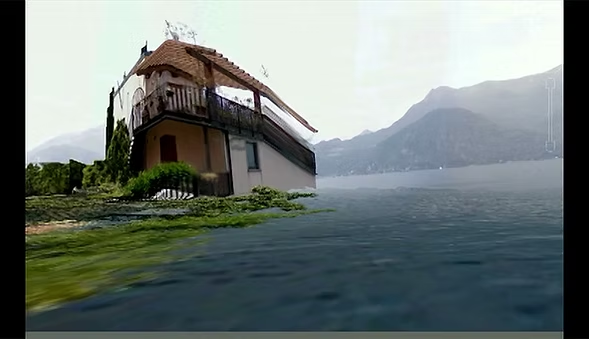
Lake Como Remix [MOGA], 2012
It represents a journey through Google Street View across Italy’s Lake Como and the surrounding landscape. Described by the artist as a “cyber-psychogeographic” trip, it experiments with the software’s functions, creating images that reveal the glitch aesthetic inherent in the imagery produced by this kind of program.
The work is part of MOGA_Museum of Glitch Aesthetics, a virtual museum and a transmedia artwork that brings together various forms of glitch art (video, animated GIFs, still images, sound art, and electronic literature). It was commissioned by the Abandon Normal Devices festival on the occasion of the London 2012 Olympic Games.
This virtual museum highlights the expressive power of error and failure, disrupting our mental construction of reality. We live in a post-digital era in which hyperreal, high-resolution imagery is pursued for its resemblance to reality. Glitch art challenges this kind of image—so characteristic of the present—through deformation.
The work is part of MOGA_Museum of Glitch Aesthetics, a virtual museum and a transmedia artwork that brings together various forms of glitch art (video, animated GIFs, still images, sound art, and electronic literature). It was commissioned by the Abandon Normal Devices festival on the occasion of the London 2012 Olympic Games.
This virtual museum highlights the expressive power of error and failure, disrupting our mental construction of reality. We live in a post-digital era in which hyperreal, high-resolution imagery is pursued for its resemblance to reality. Glitch art challenges this kind of image—so characteristic of the present—through deformation.
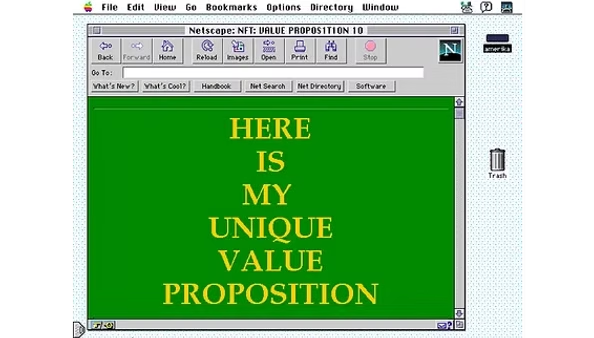
Valor [Proposicions de valor], 2021
During the pandemic, with the rise of NFTs, digital art became a growing commodity for the first time in art history. Seeing the recent explosion of interest in online digital art, in 2021 Amerika—working with an archive on a 1994 PowerBook, the same one he used to create his most iconic artwork, GRAMMATRON—decided to engage with this new speculative art market and began creating a new series of works titled Value Propositions.
These short, conceptual phrases, created on his old laptop using 30-year-old software, are a direct and playful response to the rapid commodification of digital art.
He uses an old Netscape web browser as a framing device to produce fictional web pages that have been transformed into digital prints, whose titles include the word NFT within a 1994 web browser—creating a disruption in the history of net.art.
Value Propositions offers a satirical critique of the contemporary art market, especially now that digital art is taken more seriously simply because it has increased in monetary value.
This series of works is influenced by the work of John Baldessari, Joseph Kosuth, and Jenny Holz.
These short, conceptual phrases, created on his old laptop using 30-year-old software, are a direct and playful response to the rapid commodification of digital art.
He uses an old Netscape web browser as a framing device to produce fictional web pages that have been transformed into digital prints, whose titles include the word NFT within a 1994 web browser—creating a disruption in the history of net.art.
Value Propositions offers a satirical critique of the contemporary art market, especially now that digital art is taken more seriously simply because it has increased in monetary value.
This series of works is influenced by the work of John Baldessari, Joseph Kosuth, and Jenny Holz.