Moià, 1959.
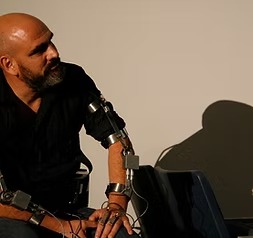
Marcel·lí Antúnez
Marcel·lí Antúnez studied Fine Arts at the Universitat de Barcelona. A multidisciplinary practitioner, he is one of the leading figures in the field of electronic art and experimental scenography. In the 1980s he was the founder and leader of the company La Fura dels Baus, which popularised action theatre. Together with Sergi Caballero and Pau Nubiola, he founded the group Los Rinos, initially focused on graffiti. Later, his activity expanded to painting, video-action performance, concerts and mural installations, such as Rinodigestión (1987), a system of interconnected wooden and glass boxes containing decomposing organic matter. In the 1990s, he began to focus on visual arts and video, and their interaction with technology. Since then, he has created a unique iconoclastic universe based on the incorporation of computational and electronic systems. His mechatronic performances and interactive installations incorporate robots and all kinds of electronic systems.
Often applied to the human body, they are described as Sistematúrgia. His graphic production includes unusual materials such as human fluids, food, textual and visual elements, using collage techniques and improvisation.
He has created installations and performances in museums, galleries, theatres and unconventional spaces in more than 40 countries, including the European Museum of Photography of the Ville de Paris, the Institute of Contemporary Arts in London, the DAF in Tokyo, MACBA in Barcelona and ZDB in Lisbon. His work includes mechatronic performances, sometimes involving robots, interactive installations and collaborations with collectives, notably La Fura dels Baus, of which he was founder and leader in the 1980s. His works have been mentioned in numerous publications worldwide. Antúnez has received, among others, the following awards and distinctions: First Prize at Festival Etrange Paris 1994, Best New Media at Noveaux Cinéma Noveaux Médias Montreal 1999, Max Award, Spain 2001, FAD Award 2001 Barcelona, Honorary Mention at Prix Ars Electronica 2003, Barcelona City Award in 2004.
Since 2010, Marcel·lí has been working on what he calls l’Arsenale della Apparizioni, which includes his three most recent pieces: the first is a performance titled Cotrone (2010), a film El Peix Sebastiano premiered at the Sitges Film Festival, and his latest performance, Pseudo (2012), first presented at the Grec Festival in Barcelona.
In 2014 he presented the exhibition Sistematurgia. Actions, Devices and Drawings at Arts Santa Mònica in Barcelona, with the intention of presenting his personal creative method based on this neologism, Sistematúrgia, understood as a dramaturgy of computational systems.
Work in the collection: Alfabeto
http://marceliantunez.com
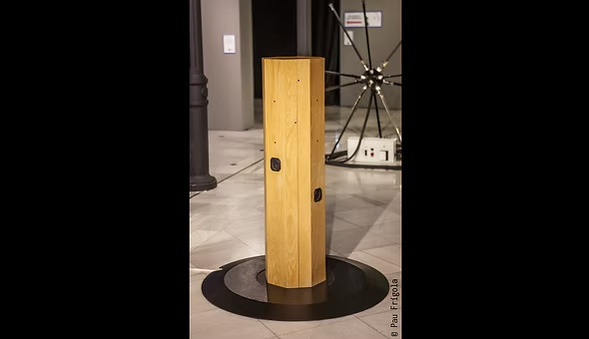
Alfabeto, 1999
“Alfabeto” consists of a wooden column with touch sensors, a platform, an audio system and a computer system. A radar detects the presence of the viewer in the room and when someone enters, the pillar moans. When the user finally touches or embraces the column, it emits sounds. These are onomatopoeic sounds organised into four emotional states: anguish, pleasure, happiness and pain. A sensor located at the top of the column identifies and selects the “emotional state”.
Alfabeto emphasises the idea of bodily interaction; the size of the trunk, its acoustic response and the need for physical participation encourage the viewer to engage in the experience.
It is normal to be moved when listening to music or to cry while watching a film. These devices are good substitutes for human emotions. However, our relationship with artistic devices is almost always passive. Alfabeto, by contrast, is an emotional prosthesis and, through its reaction, invites us to shed our passive role as receivers and become emotional actors.