
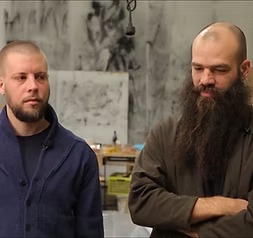
Breisach, 1983 | Berlín, 1984.
Julius von Bismarck & Benjamin Maus
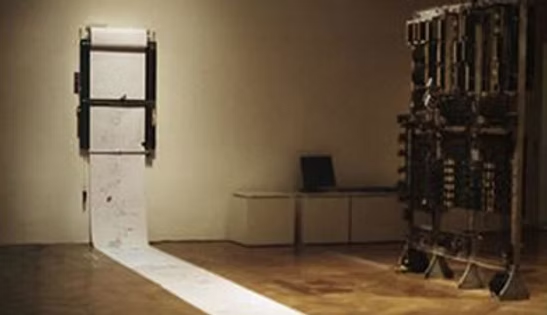
Perpetual Storytelling Apparatus, 2009
The “Perpetual Storytelling Apparatus” is a drawing machine that illustrates an endless story through the use of patent drawings. The machine translates words from a text (for example, a novel) into a stream of patent drawings. Eight million patents, linked by more than 22 million references, form the vocabulary. By using references to previous patents, it is possible to find paths between patents that have been identified for combinations of words within the story. These connections form a subtext. New visual connections and narrative layers emerge through the intertwining of the story with the representation of technical developments.
The apparatus takes a combination of words from the story and searches for a patent document whose text contains those words. It then extracts the main drawing from the patent document and draws it. As it progresses through the story, it finds the next patent document. Between the patent found and the previously drawn patent, the patents connecting the two are drawn in between. This process repeats, ingesting one story after another and generating an endless stream of patent drawings.
The first two instances of the “Perpetual Storytelling Apparatus” use the database of the United States Patent and Trademark Office. The third apparatus, recently installed at the German Patent Office in Munich, uses the entire archive of patents filed in Germany.