
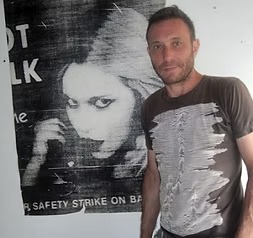
Nova York, 1997.
FakeShop
FakeShop is a collaborative group founded and led by New York artist Jeff Gompertz in 1997. One of its main characteristics is the mobility of its members depending on the piece to be produced. Its activity focuses on technological performances that question and project human reality in the face of technological society, a cyber-organized being observed and conditioned by, and subject to developments derived from the era of computing from a dystopian perspective.
Due to the fact that FakeShop’s work is essentially based on installations and complex performances, its work as an artefact is limited.
They have exhibited at BACC, Bangkok, and Public interventions, Bangkok, 2012, WTF, Bangkok, 2011, BACC, Bangkok, 2010, HYCAC, Beijing, 2008, A-space, Beijing, and 798 arts festival, Beijing, 2007, Super-deluxe, Tokyo 2006, ARCO art fair, Madrid 2005, Cooper Hewitt Museum, NYC, 2003, Franklin Furnace, NYC, 2002, Deitch Projects, NYC and The Kitchen, NYC 2001, Whitney Museum, NYC and Eyebeam, NYC, 2000, 2000 Ars Electronica, Linz, 1999, among others.
Works in the collection: “HUHB 387” and “HUHB 492”
http://fakeshop.com
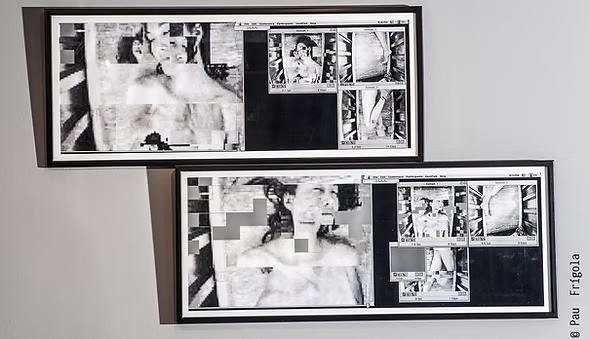
"HUHB 387" i "HUHB 492", 2000
Human Use of Human Beings (HUHB)
These prints were created during the HUHB installation, and come from a collection of similar screenshots produced during this installation at Eyebeam Atelier, NYC., 2000. In particular, they are “dual monitor” screenshots of a somewhat complex setup of 8 computers. Each runs its own *CU-SeeMe video chat webcam window and operates in a live chat session through a public server “reflector” site.
The installation of these computers took place as an off-site project of the Whitney Biennial 2000, as part of the first inclusion of net art in museums at the Biennial. Eyebeam allowed Fakeshop to use the space at that time, which was an empty garage building in Chelsea before renovation began. It was a fun process to install the ISDN line there.
Work on deposit from LaAgencia Collection.