Madrid, 1964.
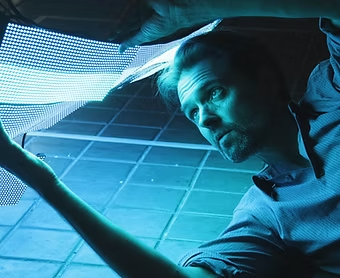
Daniel Canogar
He has created permanent public art installations using LED screens, including Aqueous at The Sobrato Organization (Mountain View, CA, 2019); Pulse at the Zachry Engineering Education Complex, Texas A&M University (College Station, TX, 2018); Tendril for Tampa International Airport (Tampa, FL, 2017); and Cannula, Xylem, and Gust II at BBVA’s headquarters (Madrid, 2018). He has also produced monumental public artworks across various media, such as Amalgama El Prado, a generative video projection cast onto the façade of the Museo Nacional del Prado and created from the museum’s painting collection (Madrid, 2019); Constellations, the largest photomosaic in Europe, created for two pedestrian bridges over the Manzanares River in Madrid Río Park (Madrid, 2010); and Asalto, a series of video projections presented on emblematic monuments, including the Arcos da Lapa (Rio de Janeiro, 2009), the Puerta de Alcalá (Madrid, 2009), and the Church of San Pietro in Montorio (Rome, 2009). He was also part of the Storming Times Square series, projected across 47 LED billboards in Times Square (New York, NY, 2014).
His solo exhibitions include Billow at bitforms gallery (New York, NY, 2020); Liquid Memories at Kubo-Kutxa Hall (San Sebastián, 2019); Augmenta, a temporary installation for the Grand Lobby Wall at the Moss Arts Center, Virginia Tech (Blacksburg, VA, 2019); Echo at the Paul and Lulu Hilliard University Art Museum (Lafayette, LA, 2019); Melt the Solids at Wilde Gallery (Geneva, 2018); Fluctuations at Sala Alcalá 31 (Madrid, 2017); Echo at bitforms gallery (New York, NY, 2017) and Max Estrella Gallery (Madrid, 2017); Sikka Ingentium at the Museum of the University of Navarra (Pamplona, 2017); Quadratura at Espacio Fundación Telefónica (Lima, 2014); Vortices at Fundación Canal Isabel II (Madrid, 2011); Synaptic Passage, a commissioned installation for the exhibition “Brain: The Inside Story” at the American Museum of Natural History (New York, NY, 2010); and two installations at the Sundance Film Festival (Park City, UT, 2011).
He has exhibited at the Museo Nacional Centro de Arte Reina Sofía (Madrid); the Wexner Center for the Arts (Ohio); Offenes Kulturhaus (Linz); Kunstsammlung Nordrhein-Westfalen (Düsseldorf); Hamburger Bahnhof (Berlin); Borusan Contemporary (Istanbul); the American Museum of Natural History (New York); The Andy Warhol Museum (Pittsburgh); the Mattress Factory (Pittsburgh); Palacio de Velázquez (Madrid); Max Estrella Gallery (Madrid); bitforms gallery (New York); Art Bärtschi & Cie Gallery (Geneva); Eduardo Secci Contemporaneo (Florence); the Alejandro Otero Museum (Caracas); and Centre d’Art Santa Mònica (Barcelona).
In 2016, Daniel Canogar and Rafael Lozano-Hemmer jointly received an Honorable Mention at the ARCO-Beep Electronic Art Award.
Works in the collection: QWERTY · Gust · Scrawl
http://www.danielcanogar.com
https://es.wikipedia.org/wiki/Daniel_Canogar
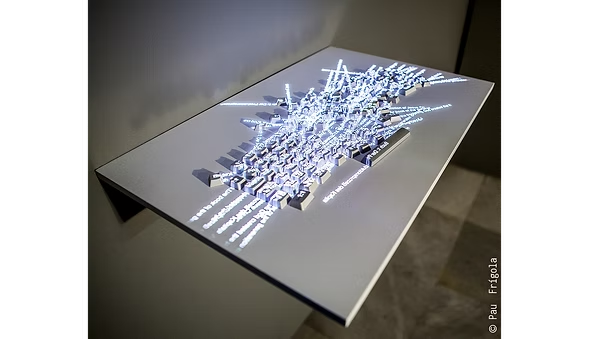
QWERTY, 2015
QWERTY presents the keys of a discarded keyboard recovered from a recycling center. A projection falls precisely onto the keys, seemingly giving new life to the old keyboard. As tools for communicating with the outside world and as repositories of many of our thoughts, we develop a very intimate relationship with our keyboards. I attempt to reveal memories—both personal and collective—that appear to be trapped within keyboards: memories from a time when the keys had a fully functional life.
The work explores the way language seems to take on a life of its own—sometimes slipping beyond our control, and at other times serving as a precise tool for the communication of thought. Other issues addressed include the constructed nature of language and the incendiary potential of the word as a medium for profound social change.
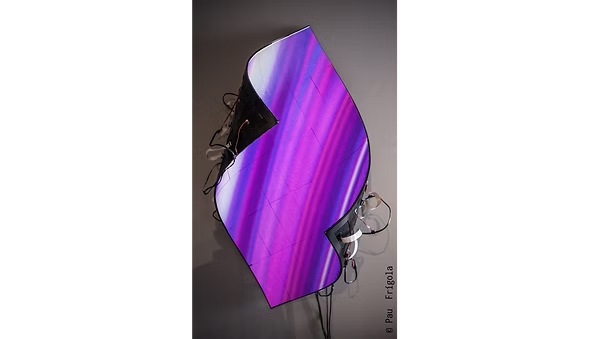
Gust, 2017
Gust is a screen made of flexible LED tiles, a technology that allows the artist to create curved displays. The generative animation reacts in real time to the speed and direction of the local wind.
The artist has observed a substantial shift in our relationship with screens. From small wrist-worn devices that monitor our biorhythms to monumental LED billboards that envelop buildings, we are surrounded by their flickering, glowing surfaces. Screens are acquiring a new materiality—a membrane-like quality that spreads across multiple surfaces, objects, and buildings. The Echo series responds to this new concept of the screen-as-skin.
The Echo screens appear to melt, exhausted by our excessive need to represent the world. In their disappearance, they reveal a new role as creatures that no longer represent but instead sense their ecosystem. Connected to the network, they perceive planetary phenomena that lie beyond our sensory capacities and yet are as vital to our survival as a species.
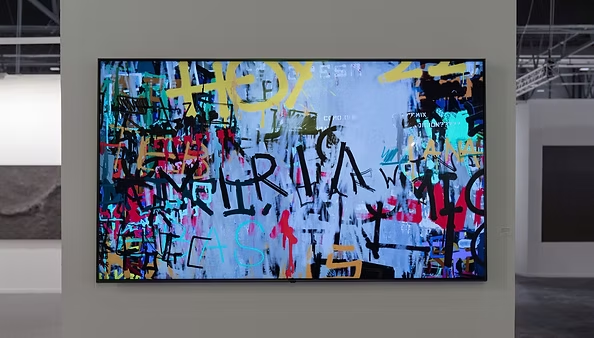
"Scrawl", 2023
It is a generative piece that reacts in real time to trending topics on X, formerly known as Twitter. The custom-built software periodically collects the most discussed topics within the X community. These topics are translated into real life through the graphic aesthetics of graffiti and street protest which, unlike professional graffiti or urban art, are created quickly and anonymously, often driven by the harshness or sincerity of their content, and sometimes as a simple declarative gesture. As a constantly evolving work, Scrawl seeks to capture the multiple tensions that coexist in social spaces such as X, where individual identity—always hidden behind the screen—is expressed in its rawest form and, paradoxically, perhaps its most real and honest.
The rhythm of Scrawl mirrors the layers of urban walls, where graffiti texts are constantly covered with flat paint, creating a new canvas for a new succession of graffiti. This translates into a struggle between the citizens’ desire for individual communication and the institutional will to erase and clean the chaotic world of graffiti. The result is an algorithmic work that continuously shifts between the aesthetics of social protest and abstract painting.
19th ARCO/BEEP Electronic Art Award.