

Kenneth Dow
Ellwangen, 1992.
Kenneth Dow explores absence and invisibility in artistic projects connecting fiction, biography and the experience of his surroundings.
Artwork in the collection
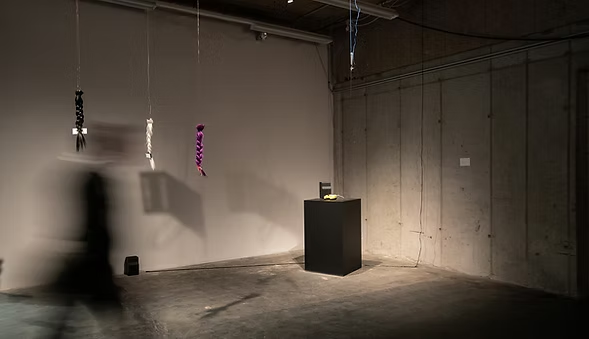
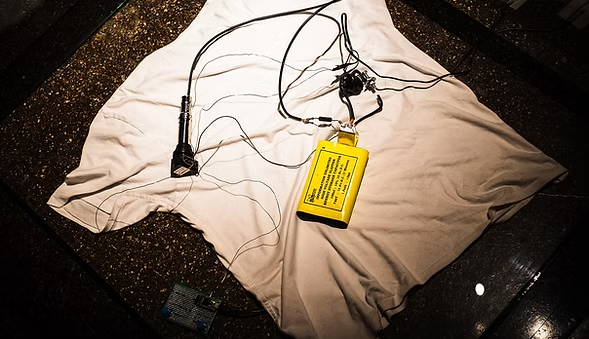
PsyCHO TRance // K-Hole, 2019.
About the artwork
In recent years, art spaces and clubs have increasingly moved closer to one another, seeking each other’s prestige, credibility, and audiences. It seems as though clubs, as cultural spaces, may respond better to the current discourse on and around art than white cubes. In their very struggle for survival, art spaces mirror capitalist conformism. The white cube is capable of digesting even the fiercest critique by separating it in time and space. In small portions it becomes indigestible for the observer without poisoning the productive, working brain.
It is sensible. It allows reflection—a sober reflection. It allows the observer to remain in their position as a bodiless spectator, possibly a free camera. Like when you’ve been killed in Counter Strike and are waiting for a new game to begin.
The club is its antithesis. Visitors may experience the loss of their ego, but never of their body. It denies its inhabitants space for detached reflection. The mere presence of the physical body makes them participants.
Perhaps this insistence on the body is what makes the club so attractive to the art world. Clubs struggle to survive alongside their neighborhoods. The interests of working bourgeois citizens to recreate their labor power are valued above a crowd that spends its vital energies without returning them to the labor market. They are the place of psychosis (chemically induced), the broken body (mind), neither willing nor fit for wage labor. The sick are the strongest form of resistance.
This observation aligns with the idea that the end of the world seems more likely than the end of neoliberalism. Rave hedonism, often read as self-aggression, is in fact an aggression against internalized discipline.
PsyCHO TRance // K-Hole is part of a research and production program organized by Hangar in collaboration with the NEWART Foundation and the.BEEP {;} collection.
Special thanks: Fabolous St. Pauli, Hamburg. Xīnchējiān 新车间, Shanghai.
Artistic career: Kenneth Dow
Artistic practice and research
In his projects, Kenneth Dow navigates through a fictional world strongly inspired by his own biography and his current environment. His artistic work deals with strategies to make the absent and the invisible perceptible: the absent as what is no longer present, and the invisible as the interior.
Career and projects
Subjective states become tangible through the selection, combination, and recursivity of procedures which together form an apparatus of representation. The representation machine thus set in motion conceives the artwork as it is presented in exhibition.
Kenneth Dow studied in Milan, Hamburg, and Shanghai and holds an MFA from the Stuttgart State Academy of Fine Arts. In 2015 he was admitted to the German Academic Scholarship Foundation (Studienstiftung des deutschen Volkes). He has participated in numerous institutional group exhibitions as well as theatre and film festivals.
Work in the collection: PsyCHO Tràngol // K-Hole