
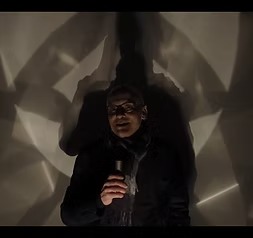
Florència, 1958.
Fabrizio Corneli
This device, based on the relationship between light and shadow, can be understood as a mechanism of polysemic metaphors that ultimately places perceptual experience at the forefront. Stories about shadows have fueled the imagination since antiquity. Romantic fantasy literature connected the shadow with a particular idea or representation of the soul. This can be seen in Adelbert von Chamisso’s well-known story Peter Schlemihl, or the Man Who Sold His Shadow, whose pages echo Goethe’s Faust, and also, although in a different way, in Andersen’s tale titled The Shadow.
This path of imagination also leads us to the shadows of Plato’s cave and its metaphors about knowledge, as well as to the myth recounted by Pliny the Elder in his Natural History to explain the birth of painting.
The legend tells that the daughter of Butades, a potter from Sicyon —whether in that city or in nearby Corinth is uncertain— drew a line on a wall tracing the silhouette of the shadow of her beloved’s head on the night before he left the city, in order to remember the features of his face. From that moment on, shadow and painting establish a paradoxical connection, while light assumes the role of illuminating in order to darken. In this sense, Corneli’s work becomes painting without paint and sculpture without volume, transforming space and forcing a constant interaction.
The form is the shadow. The image is constructed through the darkness that comes from light. The procedure is very simple, yet it involves a complex process of conception and execution. Fabrizio Corneli uses light as material and his tool is trigonometric calculation aimed at activating perceptual games through a very precise use of perspective that in turn works with shadows and reflections.
Mathematics and calculation become a methodology for the systematic dematerialization of the work. It brings together optical research and the various traditions of perspective used since the Renaissance, but reinterpreted from a contemporary perspective for an open visuality. In this way, shadow functions as an expanded extension of geometry.
Corneli’s work echoes all these paradoxes and resonances, positioning itself outside any specific movement yet at the core of experimentation on visual perception. Although light and shadow have been explored in many different ways within the international art scene, it is difficult to find a project as coherent and rigorous as Corneli’s, which uniquely connects artisanal craftsmanship with mathematical calculation, where the role of technology is minimal and generally limited to optics.
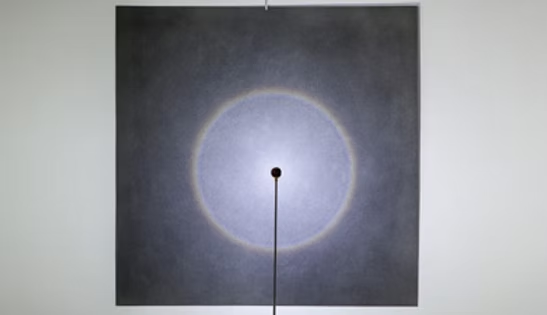
Halo, 2013
If we understand white as light and black as shadow, we could say that in my works there is neither light nor shadow, but rather a continuum of greys. The ambiguity of perception is a fundamental concept for understanding Corneli’s poetics, who adds: “Although the approach of my modus operandi is rational and mathematical, the result, at best, is difficult to focus on. The image as meaning intends to be elusive and in any case refer to a universe —that of shadows— fluid and unreliable.”