

José Manuel Berenguer
Barcelona, 1955.
José Manuel Berenguer works with sound art, electroacoustic music and interactive systems to explore perception, information and self-organising processes.
Artwork in the collection
Luci, sin nombre y sin memoria, 2008
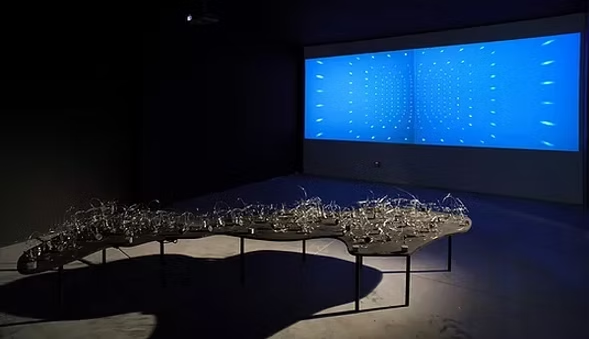
About the artwork
"Luci" reproduces the functioning of a self-organizing system inspired by the behavior of fireflies in the mangroves of Southeast Asia. It has been observed that when the male emits an intermittent signal, the female responds with a similar signal. At first, the emissions tend toward similarity before fully coinciding. This is just one example of what constitutes a general characteristic of nature: the existence of coupled oscillators, systems that tend to stabilize in certain states of periodic sequence as long as sufficiently strong fluctuations do not occur to disrupt the stability of these configurations.
"Luci" consists of 64 units, each composed of 5 transmitters, sensitive to light and sound, whose rhythmic behavior configures countless chaotic patterns that tend toward stability. The individual components have no information about the behavior of the whole, and the behavior of “Luci” is manifestly more complex than that of its components. The alteration of ambient luminosity produced by the visitor’s intervention stimulates communication among the components, provoking a new coupled configuration.
Although the polyrhythmic patterns of adaptation are not always the same, and despite the fact that the starting points and trajectories may be essentially different, they always end up in the same place. Luci is proof that the world is full of clocks that tend to coincide, and whose beats generate a sound of universal dimensions that gives us an idea of the order we believe we perceive in nature.
“Luci” is, ultimately, an allusion to the irreversibility of nature and to the absolute certainty of death.
Artistic career: José Manuel Berenguer
Artistic practice and research
Director of the Orquestra del Caos and the Música 13 Festival, founder of Nau Côclea, member of the International Academy of Electroacoustic Music of Bourges and Honorary President of the International Conference of Electroacoustic Music of the International Music Council of UNESCO, he has been awarded prizes and distinctions by institutions such as the Internationale Ferienkurse Darmstadt, the Gaudeamus Foundation, the Prix de Musique Electroacoustique de Bourges, the Concorso di Musica Elettronica – Fondazione Russolo-Pratella, the CIM-UNESCO International Rostrum of Electroacoustic Music, the Barcelona Contemporary Music Festival, Radio Nacional de España and the Castilla-La Mancha Video Prize.
Career and projects
In recent years, he has tended to express his artistic reflections through installations and real-time computer-based devices, reflecting on philosophy and the history of science, the limits of language, ethics, life and artificial intelligence, robotics, the metabolism of information, and the limits of human perception and understanding. His most recent works include installations such as Silencio, Transfer, La Casa de la Pólvora, Mega kai Mikron and Autofotóvoros, and performances such as Minf, On Nothing, Lambda-Itter (with Jane Rigler), Expanded Piano (with Agustí Fernàndez) and Desde dentro, for microscope, electric guitar and electronic generation of sound and image.
His work “Luci, sin nombre y sin memoria” won the 3rd edition of the ARCO-BEEP Electronic Art Award. Works in the collection: Luci, sin nombre y sin memoria, development of 64 modules and development of 21 modules (Luci 21 modules is on loan from the NEWART Foundation)