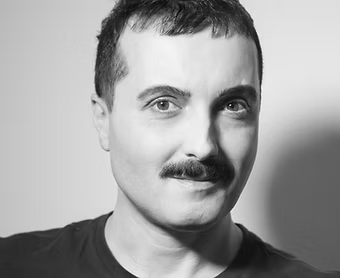
Manu Arregui
Santander, 1970
Manu Arregui is an artist exploring the relationships between digital art, video art and 3D animation. His work examines body politics and non-normative identities, combining visual experimentation, lyricism and irony.
A pioneer in incorporating 3D animation into his practice, he considers the virtualisation of everyday life and the future of art through a critical exploration of the body and identity.
Artwork in the collection
Exercises in Measuring the Affected Movement of the Hands

This work of video art by Manu Arregui, part of the NEWART Collection, investigates the codes and connotations associated with gestures. The 6-minute-30-second video uses the linear passage of time to develop this enquiry.
Starting with footage of professional dancers’ hands, the artist uses 3D modelling software to reproduce their movements and obtain position and rotation data. Dance becomes a means of exploring the fear of effeminacy, masculinisation and the social interpretation of gesture.
ARCO-BEEP Electronic Art Award
Exercises in Measuring the Affected Movement of the Hands won the 9th edition of the ARCO-BEEP Electronic Art Award.
Manu Arregui’s artistic career
Education and artistic practice
A graduate in Fine Arts from the University of the Basque Country, Manu Arregui received the Marcelino Botín Foundation’s Visual Arts Grant in 2002, enabling him to complete his training at the ISCP in New York.
International exhibitions and art fairs
His work has appeared in exhibitions including Trans-sexual Express International, curated by Xabier Arakistain and Rosa Martínez; Bad Boys, a project by Agustín Pérez Rubio presented on the occasion of the 50th Venice Biennale; and Single Channel Video: 1996–2002, curated by Juan Antonio Álvarez-Reyes and Berta Sichel for the Museo Nacional Centro de Arte Reina Sofía.
He also participated in Juan Antonio Álvarez-Reyes’s Animated Sessions project for the same museum and the Atlantic Centre of Modern Art in Las Palmas; Chacun à son Goût, curated by Rosa Martínez for the tenth anniversary of the Guggenheim Museum Bilbao; and Spanish Art 1957–2007 at the Palazzo Sant’Elia in Palermo.
His career includes international contemporary art fairs such as ARCO Madrid, Art Basel Miami Beach and Frieze London.
Awards and museum collections
In 2004 he received the First Prize for Video Creation and Digital Formats from Caixa Galicia, followed by the Altadis Award for Visual Arts in 2007.
His work is held in collections including ARTIUM in Vitoria, the Guggenheim Museum Bilbao, MUSAC in León and the Museo Nacional Centro de Arte Reina Sofía in Madrid.